Tail rot kills tissue from the tip backward, and without treatment, the infection can spread into your bearded dragon’s body and become life-threatening. This bacterial or fungal infection starts when injury, poor husbandry, or stuck shed creates an entry point for pathogens. Early-stage tail rot responds well to at-home antiseptic treatment, but advanced cases require veterinary intervention and sometimes amputation.
Key Takeaways
- Tail rot is a necrotic infection caused by bacteria or fungi that destroys tail tissue progressively from tip to base
- Early signs include dark discoloration, dry or brittle texture, swelling, and a clear line between healthy and infected tissue
- Stuck shed is not tail rot but can lead to it if circulation is cut off long enough to cause tissue death
- Mild cases can be treated at home with daily betadine soaks and topical antibiotics for 7-14 days
- Veterinary treatment costs typically range from $100-$500 depending on severity and whether amputation is needed
- Untreated tail rot spreads proximally toward the body and can cause systemic infection, sepsis, and death
- The condition is not contagious between reptiles but shared environmental problems can affect multiple animals
- Healing time varies from 2-3 weeks for early cases to 6-8 weeks post-amputation for severe infections
- Prevention focuses on proper humidity levels, regular shed monitoring, and avoiding tail injuries in your tank setup

SILVER SOLUTION FOR REPTILES – Safe formula! Natural product with no GMOs and colorants! From geckos to iguanas, this Wound Spray is designed for reptiles of all sizes and ages.

✅ 【All-in-One Skin Support】 Helps support healthy skin in reptiles dealing with tail concerns, shell dryness, shedding discomfort, and minor surface irritations.

Vitamin Enriched Formula That Provides Essential Proteins, Fats, Vitamins And Minerals
What Causes Tail Rot in Reptiles?
Tail rot in reptiles develops when bacteria (most commonly Pseudomonas or Aeromonas species) or fungi invade damaged tissue and begin destroying it. The infection requires both an entry point and conditions that favor microbial growth.
Common causes include:
- Trauma or injury, Bites from cage mates, rough handling, or tail getting caught in tank decorations
- Stuck shed, Retained shed that constricts blood flow for extended periods (24+ hours), causing tissue death
- Poor husbandry, Excessive humidity, dirty substrate, or soiled water bowls that harbor bacteria
- Thermal burns, Contact with heat sources that damage tail tissue
- Compromised immune system, Stress, malnutrition, or underlying illness that reduces infection resistance
- Substrate impaction, Ingested substrate causing internal pressure that affects circulation
The infection typically starts at the tail tip where blood supply is weakest and works backward. Bearded dragons are particularly susceptible because their tails don’t regenerate like some other lizard species, so any lost tissue is permanent.
Choose immediate veterinary care if you see rapid progression (more than 1cm in 48 hours), your dragon stops eating, or the infection reaches the base of the tail near the body.
How Do I Know If My Bearded Dragon Has Tail Rot?
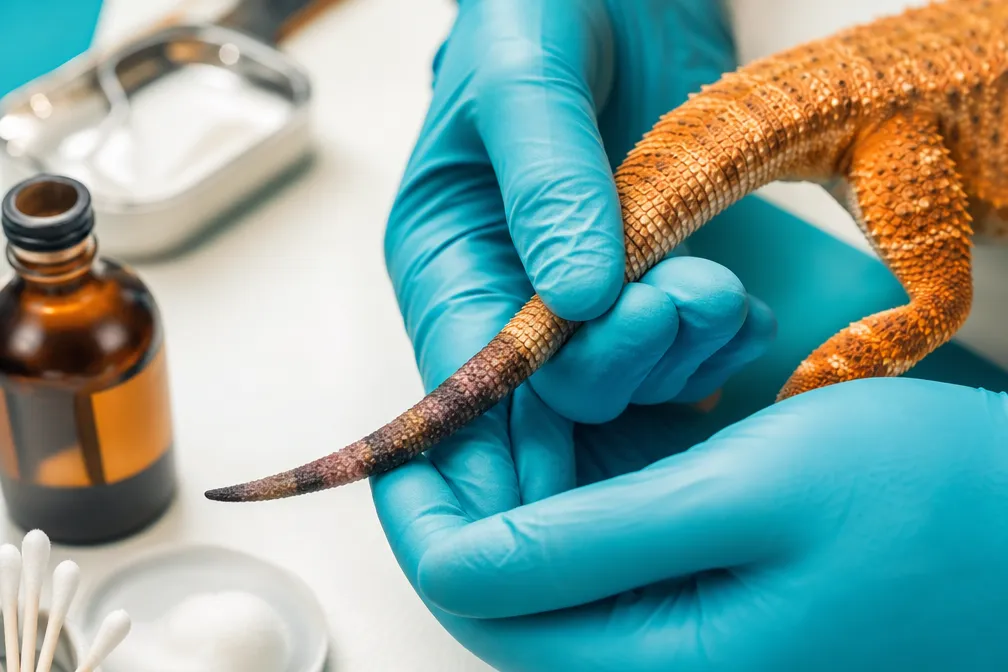
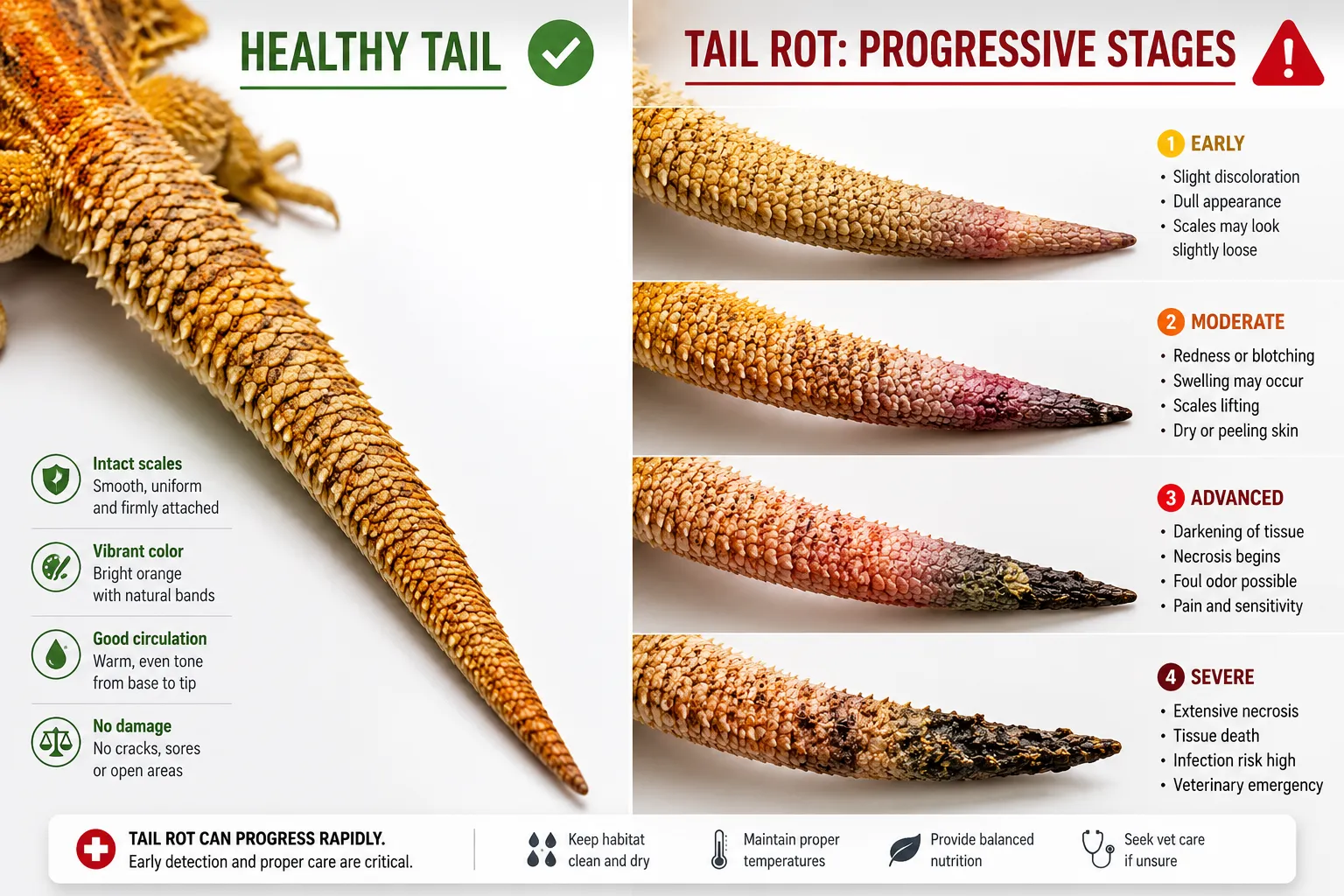
You can identify tail rot by looking for dark discoloration (black, dark brown, or gray), a dry and brittle texture at the tail tip, and a clear demarcation line between healthy and dying tissue. The affected area will feel hard rather than flexible, and the scales may appear dull or flaky.
Visual signs of tail rot:
- Color change, Starts as darkening at the very tip, progressing to black or necrotic brown
- Texture change, Affected area becomes dry, hard, and mummified rather than supple
- Clear boundary, Sharp line between healthy pink/tan tissue and dark infected tissue
- Swelling, Inflammation may appear just above the infected area
- Odor, Advanced cases produce a foul smell from decaying tissue
- Behavioral changes, Dragon may be lethargic, refuse food, or show signs of pain when tail is touched
Progression stages:
- Early stage, Small dark spot at tail tip, tissue still somewhat pliable
- Moderate stage, 1-3cm of blackened tissue, clear demarcation line, tissue hardening
- Advanced stage, Infection spreading toward body, swelling, systemic illness signs
The key difference from normal shedding is that healthy shed appears white or gray and eventually comes off to reveal normal tissue underneath, while tail rot shows progressive darkening that doesn’t resolve and continues moving up the tail.
Tail Rot vs Stuck Shed: What’s the Difference?
Stuck shed is retained skin that hasn’t come off properly during a shed cycle, appearing as white, gray, or translucent rings around the tail, while tail rot is actual tissue death that appears dark brown or black with a hard, dry texture. Stuck shed is a husbandry problem that can lead to tail rot if left untreated, but it’s not an infection itself.
How to tell them apart:
| Feature | Stuck Shed | Tail Rot |
|---|---|---|
| Color | White, gray, or translucent | Black, dark brown, or gray |
| Texture | Dry but flexible, papery | Hard, brittle, mummified |
| Removal | Can be soaked off with warm water | Cannot be removed; tissue is dead |
| Progression | Stays the same unless causing constriction | Spreads proximally over days/weeks |
| Smell | No odor | May have foul odor in advanced cases |
| Treatment | Humidity increase, soaking, gentle removal | Antiseptic treatment or amputation |
The connection: Stuck shed becomes dangerous when it forms a tight ring (constriction) that cuts off blood circulation. If circulation is blocked for 24+ hours, the tissue beyond that point dies from lack of oxygen and nutrients, creating the perfect environment for bacterial infection to take hold.
Common mistake: Owners sometimes see darkening at the tail tip during a difficult shed and assume it’s just stuck shed turning dark. If the tissue underneath is actually dying, soaking alone won’t help. Check whether the dark area is the shed itself (removable) or the tail tissue underneath (not removable).
Can Tail Rot Heal on Its Own Without Treatment?
Tail rot cannot heal on its own because necrotic (dead) tissue doesn’t regenerate and continues to harbor infection that spreads to healthy tissue. Without intervention, the infection will progress up the tail toward the body, potentially causing systemic infection, sepsis, and death.
Dead tissue must be either treated aggressively with antiseptics to stop bacterial spread or surgically removed (amputated) to prevent the infection from reaching vital organs. The body cannot “fight off” tail rot the way it might handle a minor skin infection because the compromised tissue has no blood supply to deliver immune cells or antibiotics.
What happens without treatment:
- Week 1-2, Infection advances 0.5-2cm up the tail
- Week 2-4, Swelling and inflammation spread; dragon may stop eating
- Week 4+, Bacteria enter bloodstream; systemic infection develops
- Terminal stage, Sepsis, organ failure, death
The only exception: If you catch tail rot at the absolute earliest stage (tiny dark spot, less than 3mm, caught within 24 hours), aggressive daily antiseptic treatment might prevent further spread. But even then, the already-dead tissue won’t come back to life; you’re just preventing the infection from claiming more tail.
For proper reptile care, never adopt a “wait and see” approach with suspected tail rot. The progression can be surprisingly fast, especially in stressed or immunocompromised animals.
How to Treat Early Stage Tail Rot at Home
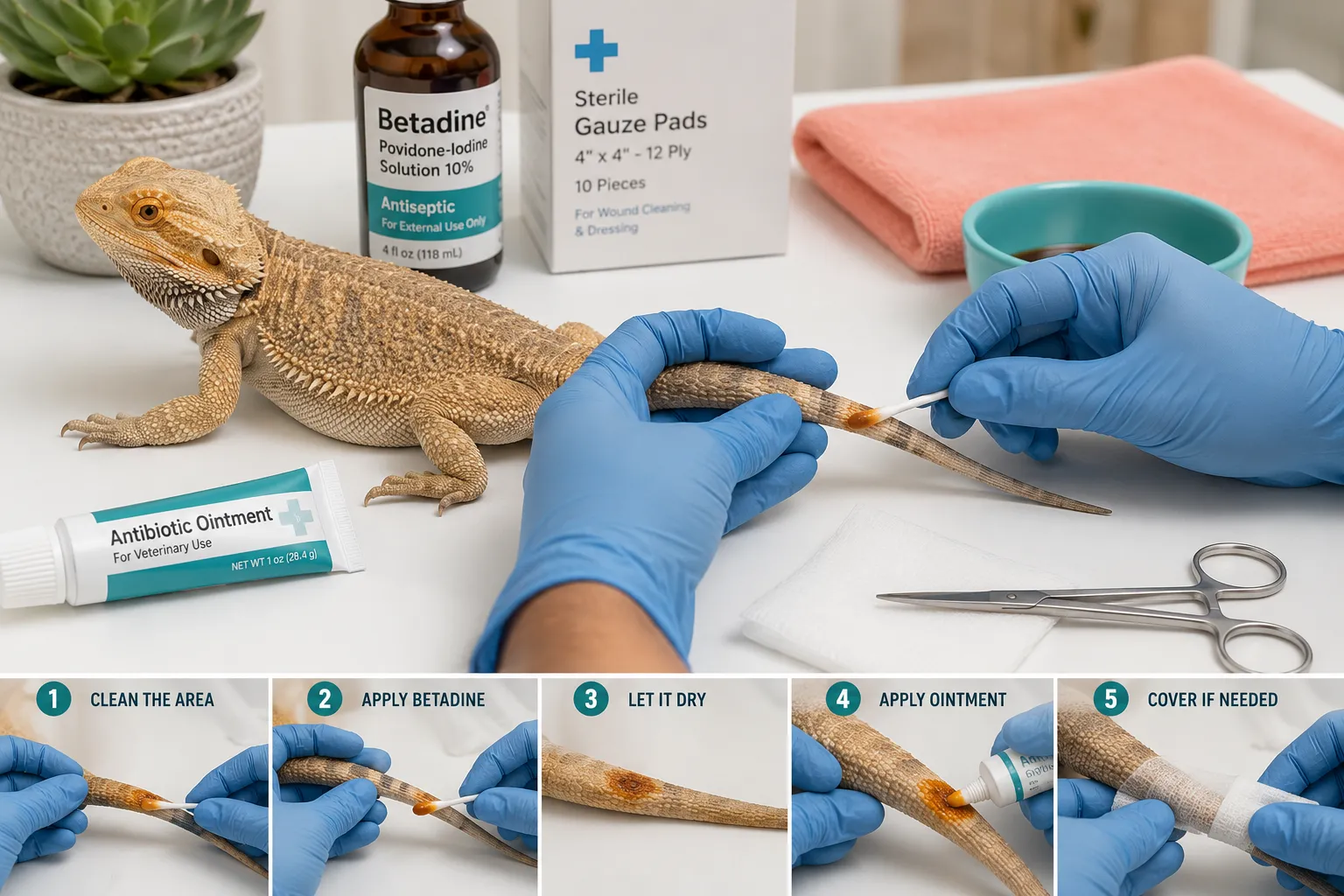
Early-stage tail rot (less than 1cm of affected tissue, caught within the first few days) can be treated at home with daily betadine soaks and topical antibiotic ointment for 7-14 days, combined with immediate husbandry corrections. This approach works only if the infection hasn’t spread significantly and your dragon is otherwise healthy.
Step-by-step home treatment protocol:
- Prepare betadine solution, Mix povidone-iodine (betadine) with warm water until it’s the color of weak tea (roughly 1:10 dilution)
- Soak the tail, Submerge the affected portion in the solution for 10-15 minutes, twice daily
- Gently pat dry, Use clean paper towels; don’t rub aggressively
- Apply antibiotic ointment, Use a thin layer of silver sulfadiazine cream or triple antibiotic ointment (without pain relievers) to the affected area
- Monitor daily, Photograph the tail each day to track whether the dark line is advancing or staying stable
- Correct husbandry, Lower humidity if too high, clean all surfaces, replace substrate if dirty, check temperatures
Treatment duration: Continue for at least 7 days after you see no further progression. Most early cases stabilize within 3-5 days and begin forming a clear separation line where the dead tissue will eventually fall off naturally.
When to stop home treatment and see a vet:
- Infection advances more than 2mm in 48 hours despite treatment
- Swelling or redness spreads up the tail
- Your dragon stops eating or becomes lethargic
- Foul odor develops
- You see any discharge or oozing
Common mistake: Using hydrogen peroxide instead of betadine. Peroxide damages healthy tissue and delays healing; betadine is the gold standard for reptile wound care.
What Antibiotics Are Used for Tail Rot?
Veterinarians typically prescribe injectable or oral antibiotics such as enrofloxacin (Baytril), ceftazidime, or amikacin for moderate to severe tail rot cases, chosen based on bacterial culture and sensitivity testing when possible. Topical silver sulfadiazine cream is the most common topical antibiotic for early cases.
Common veterinary antibiotic protocols:
- Enrofloxacin (Baytril), Broad-spectrum fluoroquinolone, given orally or by injection every 24-48 hours for 10-14 days
- Ceftazidime, Injectable cephalosporin effective against Pseudomonas, given every 72 hours for 2-3 weeks
- Amikacin, Injectable aminoglycoside for resistant infections, requires careful dosing to avoid kidney damage
- Silver sulfadiazine (Silvadene), Topical cream with broad antimicrobial activity, applied 1-2 times daily
Why you can’t just use over-the-counter antibiotics: Reptile-specific dosing is critical because their metabolism differs significantly from mammals. Human antibiotic ointments containing pain relievers (benzocaine, lidocaine) can be toxic to reptiles. Additionally, systemic infections require injectable or oral antibiotics that reach therapeutic levels in the bloodstream, which topical treatments cannot achieve.
Culture and sensitivity testing: In ideal cases, your vet will take a sample of the infected tissue, culture it to identify the specific bacteria, and test which antibiotics kill it most effectively. This prevents using the wrong antibiotic and allows targeted treatment.
Treatment duration: Most antibiotic courses run 10-21 days depending on severity. Never stop antibiotics early even if the tail looks better; incomplete treatment allows resistant bacteria to survive and multiply.
How Much Does It Cost to Treat Tail Rot at the Vet?
Veterinary treatment for tail rot typically costs $100-$500 depending on severity, with basic exams and topical treatment at the lower end and surgical amputation with anesthesia and follow-up care at the higher end. Exotic veterinarians (required for reptiles) often charge more than general practice vets.
Cost breakdown by treatment level:
- Initial exam, $50-$100
- Bacterial culture and sensitivity, $75-$150 (optional but recommended)
- Topical treatment only, $100-$200 total (exam + medications)
- Systemic antibiotics, $150-$300 (exam + injectable/oral antibiotics + follow-up)
- Surgical amputation, $300-$500+ (includes anesthesia, surgery, pain medication, follow-up visits)
- Emergency/after-hours care, Add 50-100% to above costs
Geographic variation: Urban areas and specialty exotic practices charge more than rural general vets. West Coast and Northeast U.S. prices typically run 20-40% higher than Midwest or South.
Insurance consideration: Exotic pet insurance is rare but some companies (Nationwide) offer avian and exotic coverage that may cover tail rot treatment if it’s not a pre-existing condition.
Choose amputation over prolonged antibiotic treatment if the infection has progressed beyond 30% of the tail length, isn’t responding to antibiotics after 7-10 days, or is causing systemic illness. Amputation is often more cost-effective and humane than months of unsuccessful medical management.
Do I Need to Amputate My Lizard’s Tail If It Has Tail Rot?
Amputation is necessary when tail rot has progressed beyond the early stage, isn’t responding to antibiotic treatment after 7-10 days, or threatens to spread into the body cavity. A veterinarian will amputate above the infection line in healthy tissue to ensure all necrotic and infected material is removed.
Indications for amputation:
- Infection has spread more than 3-4cm up the tail
- No improvement after 10 days of aggressive antibiotic treatment
- Systemic signs of illness (lethargy, anorexia, weakness)
- Infection approaching the base of the tail near the cloaca
- Severe pain or distress in the animal
- Foul-smelling discharge or visible bone exposure
The amputation procedure: Your vet will anesthetize your bearded dragon, surgically remove the tail at a point well above the infection in healthy tissue, cauterize blood vessels, and close the wound with sutures or surgical glue. The procedure typically takes 30-60 minutes.
Recovery expectations:
- Pain management, 5-7 days of pain medication (meloxicam is common)
- Antibiotic continuation, 10-14 days post-surgery to prevent infection
- Activity restriction, 2-3 weeks of limited climbing/jumping
- Suture removal, 10-14 days post-op if non-dissolvable sutures used
- Full healing, 4-6 weeks for complete wound closure
Life after amputation: Bearded dragons adapt remarkably well to tail loss. The tail isn’t essential for balance in terrestrial species (unlike arboreal lizards), and most dragons return to normal behavior within 2-3 weeks. The tail will not grow back, but this doesn’t significantly impact quality of life.
Common concern: “Will amputation traumatize my dragon?” Reptiles don’t experience emotional trauma the way mammals do. The physical stress of surgery is temporary, while untreated tail rot causes prolonged suffering and death.

VETERINARY ANTISEPTIC BARRIER OINTMENT: F10 Antiseptic Barrier Ointment forms a protective barrier over cuts, abrasions, and minor skin irritations, helping maintain a clean wound environment for reptiles, birds, small animals, and exotic pets.

VETERINARY ANTISEPTIC WOUND SPRAY WITH INSECTICIDE: F10 Antiseptic Wound Spray with Insecticide is a veterinary topical wound care spray formulated for reptiles, birds, small animals, and exotic pets. Helps protect cuts, wounds, abrasions, and minor skin irritations during routine wound care.
Can Tail Rot Spread to Other Parts of the Body?
Yes, tail rot can spread systemically if bacteria enter the bloodstream, causing septicemia (blood infection) that affects internal organs including the liver, kidneys, and heart. The infection can also spread locally through connective tissue if it reaches the base of the tail near the cloaca and body cavity.
Progression pathways:
- Local spread, Infection moves up the tail through tissue, following blood vessels and bone
- Systemic spread, Bacteria enter circulation through damaged blood vessels, seeding distant organs
- Secondary infections, Weakened immune system allows opportunistic infections in mouth, respiratory system, or digestive tract
Signs of systemic infection:
- Lethargy and weakness
- Complete loss of appetite
- Difficulty breathing or open-mouth breathing
- Discoloration spreading beyond the tail
- Swelling in the abdomen or limbs
- Neurological signs (head tilt, seizures) in severe cases
Timeline: Local spread happens gradually over weeks, while systemic spread can occur suddenly once bacteria breach into major blood vessels. This is why early treatment is critical; once infection becomes systemic, mortality rates increase dramatically even with aggressive treatment.
Prevention of spread: Prompt treatment with appropriate antibiotics, surgical removal of infected tissue before it reaches the tail base, and maintaining optimal husbandry to support immune function all reduce the risk of systemic spread.
This is why tail rot is never “just cosmetic”, it’s a progressive infection that will eventually threaten your dragon’s life if not addressed.
How Long Does It Take for Tail Rot to Heal?
Early-stage tail rot treated promptly typically stabilizes within 3-5 days and fully resolves in 2-3 weeks as the dead tissue naturally separates and falls off. Moderate cases requiring systemic antibiotics take 4-6 weeks to heal completely, while surgical amputation cases need 6-8 weeks for full wound healing and recovery.
Healing timeline by severity:
Early stage (home treatment):
- Days 1-3: Infection stops advancing
- Days 4-7: Clear demarcation line forms
- Weeks 2-3: Dead tissue dries and falls off naturally
- Week 4: Healed tissue visible, monitoring continues
Moderate stage (veterinary antibiotics):
- Week 1: Infection stabilizes with treatment
- Weeks 2-3: Inflammation reduces, tissue begins separating
- Weeks 4-6: Complete healing, dead tissue removed or fallen off
Severe stage (amputation):
- Days 1-7: Post-surgical wound care, pain management
- Weeks 2-3: Suture removal, wound closing
- Weeks 4-6: Complete wound closure
- Weeks 6-8: Full return to normal activity
Factors affecting healing speed:
- Age, Younger dragons heal faster than older ones
- Nutrition, Well-fed dragons with proper supplementation recover more quickly
- Husbandry, Optimal temperatures and humidity support healing
- Immune status, Stressed or ill dragons heal more slowly
- Treatment compliance, Consistent medication administration is critical
Common mistake: Stopping treatment too early because the tail “looks better.” Continue the full antibiotic course and maintain monitoring for at least 2 weeks after visible improvement to prevent relapse.
During healing, maintain your dragon’s normal routine as much as possible while avoiding activities that could re-injure the tail. Proper reptile care during recovery significantly impacts healing speed.
What Happens If You Don’t Treat Tail Rot?
Untreated tail rot will progressively destroy more tail tissue, eventually reaching the base of the tail and entering the body cavity where it causes septicemia, organ failure, and death within weeks to months depending on the infection’s virulence and the animal’s immune response. The process is painful and causes significant suffering.
Progression of untreated tail rot:
Weeks 1-2:
- Infection advances 1-3cm up the tail
- Pain and discomfort increase
- Appetite may decrease
Weeks 2-4:
- 30-50% of tail affected
- Swelling and inflammation visible
- Behavioral changes (hiding, lethargy)
- Weight loss begins
Weeks 4-8:
- Infection reaches tail base
- Systemic signs appear (severe lethargy, anorexia)
- Secondary infections develop
- Visible suffering
Weeks 8+:
- Septicemia develops
- Organ failure begins
- Seizures or neurological signs
- Death
Why it’s not humane to “let nature take its course”: Unlike wild animals where natural selection operates, captive reptiles depend entirely on their owners for medical care. Allowing a preventable infection to kill a pet dragon over weeks or months constitutes neglect and causes unnecessary suffering.
The economic argument: Early treatment costs $100-$200. Waiting until the infection is severe costs $300-$500 for emergency amputation, with lower success rates. Waiting even longer results in a dead pet and the full cost of replacement plus the emotional toll.
Legal consideration: In many jurisdictions, failing to provide necessary veterinary care for a treatable condition constitutes animal cruelty and can result in fines, loss of pet ownership rights, or criminal charges.
Is Tail Rot Contagious to Other Reptiles in the Same Tank?
Tail rot itself is not directly contagious between reptiles because it requires damaged tissue as an entry point, but the bacteria causing tail rot can spread through shared water sources, substrate, or direct contact with infected tissue. Multiple animals in the same enclosure can develop tail rot if they share the same poor husbandry conditions that predispose to infection.
Transmission risks:
- Shared water bowls, Bacteria from infected tissue contaminate water that other animals drink or soak in
- Contaminated substrate, Bacteria survive in moist substrate and can infect other animals with minor wounds
- Direct aggression, Bites or scratches from an infected animal can transfer bacteria
- Shared environmental problems, High humidity, poor sanitation, or temperature issues affect all animals equally
Risk mitigation if you have multiple dragons:
- Separate immediately, Isolate any dragon showing signs of tail rot
- Disinfect thoroughly, Clean and disinfect the entire enclosure with reptile-safe disinfectant (10% bleach solution, rinsed thoroughly)
- Replace substrate, Discard all substrate and start fresh
- Separate water sources, Never allow animals to share water bowls
- Monitor closely, Check all other animals daily for early signs of infection
- Address husbandry, Fix whatever environmental problem allowed the infection to develop
Important note: Bearded dragons should not be housed together in the first place. They are solitary animals, and cohabitation causes stress, competition for resources, and aggression that leads to injuries (including tail damage). If you’re keeping multiple dragons together and one develops tail rot, the housing situation itself is likely contributing to the problem.
The bacteria (Pseudomonas, Aeromonas, etc.) are opportunistic pathogens present in many environments. They only cause disease when conditions favor their growth and an animal has compromised tissue or immune function.
Best Betadine Solution for Tail Rot Treatment
Povidone-iodine solution (betadine) at 10% concentration, diluted to the color of weak tea (approximately 1:10 ratio with warm water), is the gold standard antiseptic for treating tail rot in reptiles. Use the standard betadine solution, not betadine surgical scrub which contains detergents that can irritate tissue.
Product specifications:
- Active ingredient, Povidone-iodine 10%
- Form, Liquid solution (not scrub, not ointment)
- Brand examples, Betadine Solution, generic povidone-iodine solution
- Where to buy, Pharmacies, online retailers, veterinary suppliers
- Cost, $8-$15 for 8-16 oz bottle
Proper dilution method:
- Fill a small container with warm (not hot) water, approximately 85-90°F
- Add povidone-iodine solution gradually while stirring
- Stop when the water reaches the color of weak tea (light amber)
- Test temperature before submerging your dragon’s tail
- Prepare fresh solution for each treatment session
Why this concentration: Full-strength betadine is too harsh and can damage healthy tissue. The diluted solution maintains antimicrobial effectiveness while being gentle enough for repeated use on sensitive reptile skin.
Application technique:
- Submerge only the affected portion of the tail
- Keep the solution in contact for 10-15 minutes
- Gently agitate the water occasionally to ensure coverage
- Pat dry thoroughly after soaking
- Apply topical antibiotic ointment after drying
Alternatives if betadine is unavailable: Chlorhexidine solution (diluted to 0.05%) is a second choice, though betadine is preferred for reptile wound care. Never use hydrogen peroxide, rubbing alcohol, or tea tree oil, which damage tissue and delay healing.
Storage: Keep betadine solution in its original brown bottle away from light. Discard if it becomes clear (indicates loss of potency). Properly stored betadine remains effective for 2-3 years.
Can Fish Get Tail Rot or Is It Only Reptiles?
Fish can develop a condition also called “tail rot” or “fin rot,” but it’s caused by different bacteria (typically Flavobacterium columnare or Aeromonas species) and occurs in a completely different environment (aquatic vs. terrestrial). The term “tail rot” describes similar symptoms (tissue necrosis starting at extremities) but the underlying causes, treatment, and prevention differ significantly between fish and reptiles.
Key differences:
| Aspect | Reptile Tail Rot | Fish Fin/Tail Rot |
|---|---|---|
| Primary cause | Trauma + bacterial infection in damaged tissue | Poor water quality + bacterial infection |
| Common bacteria | Pseudomonas, Aeromonas, Proteus | Flavobacterium, Aeromonas, Pseudomonas |
| Environment | Terrestrial; requires entry wound | Aquatic; bacteria in water column |
| Treatment | Topical antiseptics, systemic antibiotics, amputation | Water quality improvement, aquarium antibiotics |
| Prevention | Proper humidity, injury prevention, clean substrate | Regular water changes, filtration, low stocking density |
| Contagion | Not directly contagious | Can spread through contaminated water |
Why the confusion exists: Both conditions involve bacterial necrosis of tail tissue and share some bacterial species (Aeromonas affects both fish and reptiles). The term “rot” accurately describes the tissue destruction in both cases.
Treatment crossover: Some aquarium antibiotics (like kanamycin or nitrofurazone) can theoretically treat reptile infections, but dosing, administration route, and efficacy differ. Never use fish medications on reptiles without veterinary guidance, and vice versa.
For bearded dragon owners: If you also keep fish and notice tail rot in your aquarium, the two conditions are unrelated. The bacteria won’t jump from your fish tank to your dragon’s enclosure. However, poor husbandry practices (infrequent cleaning, high humidity, contaminated water) can cause problems in both environments.
Understanding that “tail rot” describes a symptom pattern rather than a single disease helps clarify why treatment approaches differ across species.
Frequently Asked Questions
Can I use Neosporin on my bearded dragon’s tail rot?
Only use plain triple antibiotic ointment without pain relievers (benzocaine, lidocaine, or pramoxine), as these ingredients are toxic to reptiles. Check the label carefully; many Neosporin products contain pain relievers. Silver sulfadiazine cream is safer and more effective for reptile wound care.
How can I tell if tail rot is getting better or worse?
Take daily photos of the affected area and measure the dark tissue with a ruler. Improvement shows as the infection line staying stable or the dead tissue beginning to separate with a clear demarcation. Worsening shows as the dark area advancing up the tail, increased swelling, or development of odor.
Should I pull off the dead tail tissue myself?
Never forcibly remove dead tissue. It will naturally separate and fall off once healing occurs underneath, typically 2-4 weeks after treatment begins. Pulling it prematurely causes bleeding, pain, and risk of introducing new infection. Only remove tissue that has completely separated and comes off with no resistance.
Can tail rot happen during brumation?
Yes, tail rot can develop during brumation if your dragon enters the dormant period with an existing injury or stuck shed. Check your dragon weekly during brumation for any signs of tail discoloration or injury, even though they’re less active.
Will my bearded dragon’s tail grow back after tail rot?
No, bearded dragons cannot regenerate lost tail tissue. Unlike some lizard species that can regrow tails, bearded dragons will have a permanently shortened tail after tissue loss from tail rot or amputation. The remaining tail will heal and function normally.
Can tail rot be prevented with supplements or diet changes?
While proper nutrition supports immune function and wound healing, tail rot is primarily a husbandry and injury-prevention issue rather than a nutritional disease. Focus on maintaining proper humidity (30-40%), preventing injuries, monitoring sheds, and keeping the enclosure clean rather than relying on supplements to prevent infection.
Is tail rot more common in baby or adult bearded dragons?
Tail rot can occur at any age, but babies are more susceptible to stuck shed issues due to more frequent shedding, while adults may be more prone to injury-related tail rot from established territorial behaviors or declining immune function in older animals.
Can I treat tail rot with natural remedies like honey or coconut oil?
While honey has antimicrobial properties, it’s not appropriate for reptile wound care because it’s too sticky and can trap debris. Coconut oil has no proven efficacy against the bacteria causing tail rot. Stick with veterinary-recommended antiseptics like betadine and prescribed antibiotics for reliable treatment.
How often should I change the betadine solution during treatment?
Prepare fresh betadine solution for each treatment session (twice daily). Don’t reuse solution from previous treatments as it becomes contaminated with bacteria and loses effectiveness. Each soak should use newly diluted solution at the proper concentration.
Can tail rot cause permanent damage even after successful treatment?
The tail tissue that dies from tail rot is permanently lost and won’t regenerate, but successfully treated tail rot doesn’t cause ongoing health problems once the infection is cleared. Your dragon will adapt to a shorter tail without long-term complications if treatment is successful.
Should I increase my bearded dragon’s basking temperature during tail rot treatment?
Maintain normal basking temperatures (95-105°F) rather than increasing them. Proper temperature supports immune function and healing, but excessive heat can cause stress and dehydration that impair recovery. Focus on maintaining optimal husbandry rather than making dramatic changes during treatment.
Can tail rot recur after successful treatment?
Tail rot can recur if the underlying husbandry problems aren’t corrected or if your dragon experiences new injuries. Once the initial infection is cleared, the risk of recurrence is low if you maintain proper humidity, prevent injuries, and monitor sheds carefully. The same tail won’t develop rot twice in the exact same location since that tissue is gone, but new infections can develop in previously healthy areas.
Conclusion
Tail rot is a serious but treatable condition that requires prompt recognition and appropriate intervention. Early-stage infections respond well to home treatment with betadine soaks and topical antibiotics, while advanced cases need veterinary care including systemic antibiotics or surgical amputation. The key to successful outcomes is catching the infection early, treating it aggressively, and correcting the husbandry issues that allowed it to develop.
Take these action steps today:
- Inspect your dragon’s tail, Check for any dark discoloration, stuck shed, or texture changes
- Review your husbandry, Verify humidity levels (30-40%), temperature gradients, and substrate cleanliness in your bearded dragon tank
- Stock first aid supplies, Keep betadine solution and silver sulfadiazine cream on hand for immediate treatment if needed
- Find an exotic vet now, Locate a qualified reptile veterinarian before you need emergency care
- Monitor sheds carefully, Check for stuck shed after each shedding cycle and remove it promptly with soaking
Remember that tail rot is preventable through proper husbandry and attentive care. By maintaining optimal environmental conditions, monitoring your dragon regularly, and acting quickly at the first sign of problems, you can protect your bearded dragon from this potentially life-threatening infection. When in doubt, always consult with a qualified reptile veterinarian rather than waiting to see if the problem resolves on its own.

Effective shedding aid:Specifically designed to address shedding difficulties in pet reptiles. Its rough surface provides gentle yet effective physical friction, helping to safely remove stubborn stuck shed skin and make the shedding process smoother.

Unique textured pellets that bearded dragons love to eat

Versatile Design: Multi-purpose reptile tank cleaner made specifically for bearded dragon enclosures and terrariums. Keeps your pet’s habitat clean, odor-free, and hygienic with a powerful formula that tackles waste, grime, and buildup on contact.