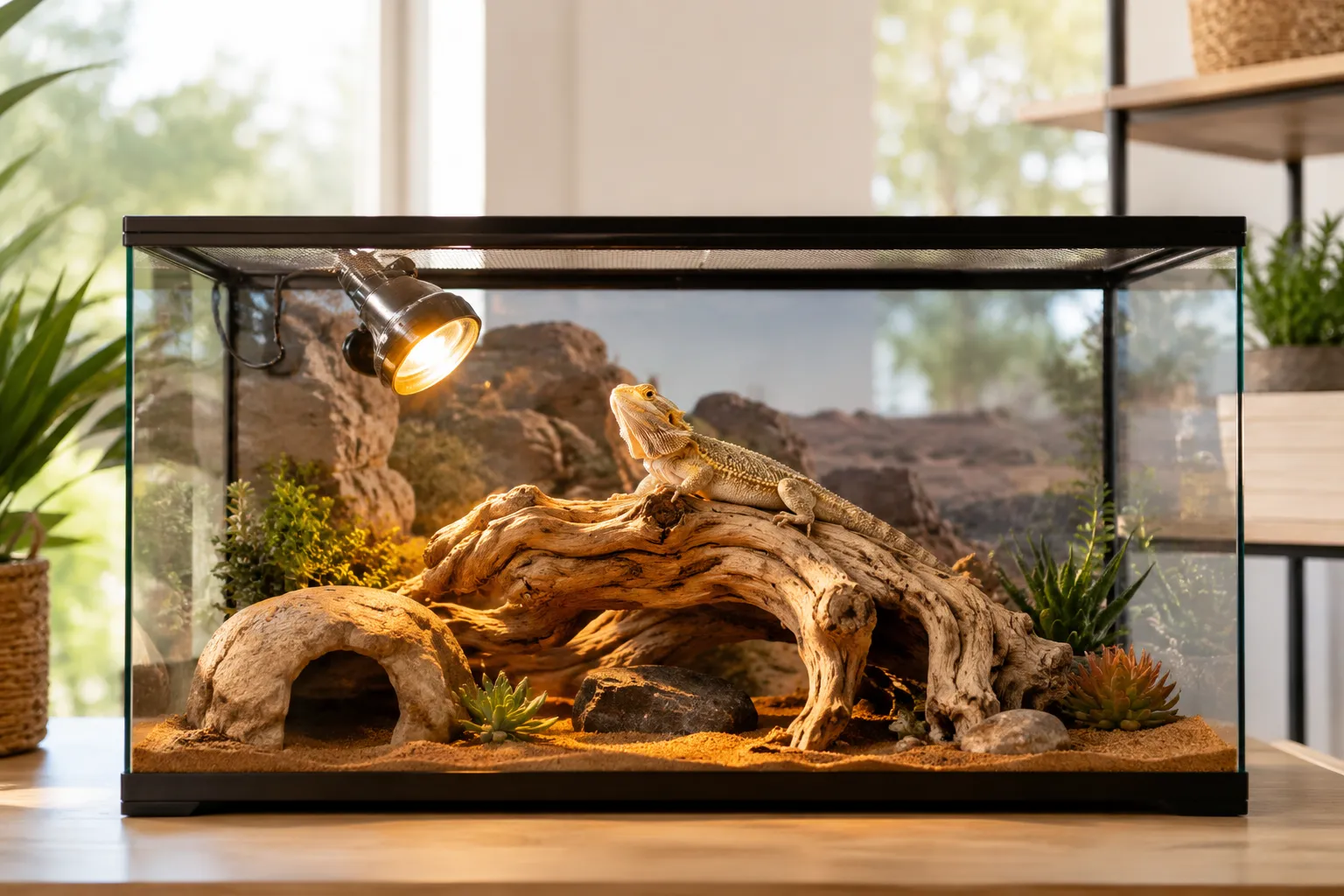
Quick Answer: Adult bearded dragons need a minimum 120-gallon (4 feet long x 2 feet wide x 2 feet tall) tank, while juveniles can start in a 40-gallon tank and upgrade as they grow. The tank must be horizontal rather than vertical because bearded dragons are ground-dwelling lizards that need floor space more than height. Anything smaller than 120 gallons for an adult will restrict their movement and can lead to stress and health problems.
Key Takeaways
- Adult bearded dragons require a minimum 120-gallon tank (48″ L x 24″ W x 24″ H) for proper movement and thermoregulation
- Baby bearded dragons (0-6 months) can start in a 40-gallon tank but will need upgrades as they grow
- Horizontal tanks are essential because bearded dragons are terrestrial lizards that need floor space, not climbing height
- A 75-gallon tank is too small for adult bearded dragons and should only be used as a temporary solution during growth stages
- Tank setup costs range from $300-$800 depending on size and equipment quality
- Upgrading tank size should happen at 6 months and again at 12 months to match growth stages
- Two bearded dragons should never share one tank due to territorial aggression and dominance behaviors
- A tank cannot be “too big” as long as you maintain proper temperature gradients and the dragon can find food easily
- Common mistakes include buying too small initially and trying to save money with vertical tanks that don’t meet their needs
- Glass tanks are standard, but PVC enclosures and custom builds offer better insulation and customization options

Spacious 120-Gallon Terrarium - This premium 4x2x2 reptile enclosure offers a generous 120-gallon capacity, ideal for bearded dragons, snakes, geckos, and other medium-to-large reptiles. Whether you're housing one majestic pet or creating a cohabitation environment, this large reptile tank provides ample room for natural behaviors, enrichment, and comfort. TIP: This tank is not suitable for holding water. (Note: Shipped by 2 boxes, may arrive separately.)

[A Spacious World for Your Reptiles] Transform your reptile’s environment with this extra-large 120 gallon terrarium. The 4x2x2 design offers generous room for climbing branches, basking zones, and multiple hides — ideal for bearded dragons, snakes, and larger lizards, or even cohabiting pets. (Note: Shipped by 2 boxes, may arrive separately.)

【Size Matter】Phailozoo 120 gallon reptile terrarium measures 48" Lx 24" W x 24"H, perfect for desert and rainforest bioactive setups, such as bearded dragon tank, snake tank, and lizard tank. Spacious playground for your beloved reptiles to explore and thrive while being safe.
What Is the Minimum Tank Size for a Bearded Dragon?
The absolute minimum tank size for an adult bearded dragon is 120 gallons with dimensions of 48 inches long, 24 inches wide, and 24 inches tall. This size allows the dragon to move freely, establish proper temperature gradients, and exhibit natural behaviors like pacing and exploring.
Anything smaller than 120 gallons restricts an adult bearded dragon’s movement and prevents proper thermoregulation. Bearded dragons need a basking spot at 95-105°F and a cool side at 75-85°F, which requires adequate horizontal space to create this gradient.
Why 120 gallons matters:
- Adult bearded dragons reach 18-24 inches in length and need room to turn around comfortably
- They are active during the day and explore their entire enclosure regularly
- Proper temperature zones require at least 4 feet of horizontal space
- Inadequate space leads to stress, pacing behavior, and potential health issues
Common mistake: Many pet stores recommend 75-gallon tanks as “adequate” for adults, but this is a compromise that prioritizes retail space over animal welfare. While a dragon can survive in 75 gallons, it cannot thrive.
What Size Tank for Baby Bearded Dragon vs Adult?

Baby bearded dragons (0-6 months) can start in a 40-gallon tank, juveniles (6-12 months) need at least 75 gallons, and adults (12+ months) require a minimum 120-gallon enclosure. This staged approach allows you to match tank size to the dragon’s growth while avoiding overwhelming a tiny hatchling in a massive space.
Tank size by age:
- Hatchling (0-3 months): 20-40 gallon tank
- Juvenile (3-6 months): 40-75 gallon tank
- Sub-adult (6-12 months): 75-120 gallon tank
- Adult (12+ months): 120+ gallon tank minimum
Starting babies in smaller tanks helps them find food more easily and feel secure. Hatchlings can become stressed in overly large spaces where they struggle to locate crickets or feel exposed to perceived threats.
Choose a smaller starter tank if:
- Your dragon is under 6 inches long
- You’re concerned about feeding efficiency (babies need to eat 2-3 times daily)
- You want to minimize initial setup costs
Go straight to a 120-gallon tank if:
- You’re adopting a sub-adult or adult dragon
- You want a permanent setup without future upgrades
- You don’t mind the higher upfront cost
Is a 40 Gallon Tank Big Enough for a Bearded Dragon?
A 40-gallon tank is only appropriate for baby bearded dragons under 6 months old and should be considered a temporary starter enclosure. Adult bearded dragons absolutely cannot live long-term in a 40-gallon tank without experiencing stress, restricted movement, and potential health problems.
The dimensions of a standard 40-gallon breeder tank (36″ L x 18″ W x 18″ H) provide enough space for a hatchling to hunt food and establish basic temperature zones, but an adult dragon measuring 18-24 inches cannot turn around comfortably or move freely.
Signs your dragon has outgrown a 40-gallon tank:
- Constantly pacing or glass surfing along the walls
- Unable to fully stretch out diagonally
- Difficulty establishing proper basking and cool zones
- Body length exceeds 12 inches
- Age reaches 6 months
Plan to upgrade from a 40-gallon tank by the time your bearded dragon reaches 6 months of age or 12 inches in length, whichever comes first.
75 Gallon vs 120 Gallon Tank for Bearded Dragon
A 120-gallon tank is significantly better than a 75-gallon for adult bearded dragons because it provides the minimum 4 feet of horizontal length needed for proper temperature gradients and natural movement patterns. A 75-gallon tank (48″ L x 18″ W x 21″ H) offers adequate length but lacks the width and overall floor space that promotes healthy behavior.
75-gallon tank pros:
- Lower cost ($150-250 vs $300-500)
- Easier to fit in smaller rooms
- Adequate for sub-adults during transition period
- Acceptable as temporary housing during upgrades
75-gallon tank cons:
- Only 18 inches wide limits side-to-side movement
- Less floor space for enrichment items
- Harder to create distinct temperature zones
- Adult dragons appear cramped
120-gallon tank pros:
- Meets minimum welfare standards for adults
- 24-inch width allows comfortable turning
- Better temperature gradient establishment
- Room for multiple hides, basking spots, and enrichment
- Dragon displays more natural behaviors
120-gallon tank cons:
- Higher upfront cost
- Requires more floor space in your home
- Heavier and harder to move
Choose 75 gallons if: You’re housing a sub-adult (6-12 months) temporarily or need a budget-conscious intermediate step before upgrading to 120 gallons.
Choose 120 gallons if: You’re setting up for an adult dragon or want a permanent enclosure that won’t need future upgrades.

How Much Does a Bearded Dragon Tank Setup Cost?
A complete bearded dragon tank setup costs between $300-800 depending on tank size and equipment quality, with the tank itself representing only 30-40% of the total investment. Budget setups with basic equipment start around $300, while premium setups with high-quality lighting and custom décor can exceed $800.
Cost breakdown for a 120-gallon setup:
- Tank: $300-500 (glass) or $400-700 (PVC enclosure)
- UVB lighting: $50-150 (tube fixture and bulb)
- Heat lamp and bulb: $30-60
- Thermometers/hygrometers: $15-30
- Substrate: $20-40
- Hides and décor: $50-100
- Food and water dishes: $15-25
- Initial supplies (calcium, food): $30-50
Total: $510-1,155
Budget-saving strategies:
- Buy used tanks from local classifieds (inspect for cracks)
- Purchase complete kits during holiday sales
- Start with a 40-gallon for babies and upgrade later
- DIY décor using safe rocks and branches from outdoors
- Buy UVB bulbs in multi-packs for long-term savings
Don’t cheap out on: UVB lighting (critical for calcium absorption and bone health) and thermostats (prevent burns and overheating).
Can a Bearded Dragon Tank Be Too Big?
A bearded dragon tank cannot be too big as long as you maintain proper temperature gradients and the dragon can locate food easily. Larger enclosures actually promote more natural behaviors and reduce stress, contrary to the myth that big spaces overwhelm reptiles.
The concern about oversized tanks stems from two legitimate issues that are easily solved:
Temperature gradient challenges: In very large enclosures (150+ gallons), you may need multiple heat sources to maintain a proper basking spot while keeping the cool end at the right temperature. Solution: Use a higher-wattage basking bulb or add a secondary heat source.
Feeding difficulties for babies: Hatchlings in massive enclosures may struggle to catch fast-moving crickets. Solution: Feed in a smaller area or use feeding dishes for easier access.
Benefits of larger tanks:
- More space for enrichment and climbing structures
- Better air circulation and temperature stability
- Reduced stress from feeling confined
- Room for the dragon to exercise and explore
- Easier to create multiple basking and hiding spots
If you have space and budget for a 150-gallon or larger custom enclosure, your bearded dragon will benefit from the extra room. Just ensure you can maintain proper temperatures throughout and monitor feeding success.
My Bearded Dragon Seems Stressed in New Tank What to Do
When a bearded dragon seems stressed in a new tank, give them 7-10 days to adjust while ensuring proper temperatures, providing multiple hides, and minimizing handling during the transition period. Stress behaviors like glass surfing, hiding constantly, or refusing food are normal for the first week as the dragon acclimates to new surroundings.
Immediate steps to reduce stress:
- Verify temperatures: Basking spot should be 95-105°F, cool side 75-85°F
- Add more hides: Provide at least one hide on the warm side and one on the cool side
- Reduce handling: Limit interaction to feeding only for the first week
- Cover three sides: Use background paper or cardboard to create visual security
- Maintain routine: Feed at the same times daily
- Check lighting: Ensure UVB is working and positioned correctly
Normal adjustment behaviors (should improve within 10 days):
- Glass surfing or pacing for short periods
- Spending more time hiding than usual
- Reduced appetite for 2-3 days
- Darker beard coloration
- Wariness of movement outside the tank
Signs of a real problem (address immediately):
- Refusing food for more than 5 days
- Lethargy and constant hiding beyond 2 weeks
- Gaping mouth while not basking (sign of overheating)
- Aggressive behavior when you approach
- Physical symptoms like closed eyes or labored breathing
Common causes of ongoing stress:
- Tank is too small for the dragon’s size
- Temperatures are incorrect (use multiple thermometers to verify)
- No proper UVB lighting
- Tank is in a high-traffic area with constant disturbance
- Reflections in glass make the dragon think there’s another dragon
If stress behaviors continue beyond 2 weeks despite proper setup, consult a reptile veterinarian to rule out health issues.
Best Tank Brands for Bearded Dragons
The best tank brands for bearded dragons include Zen Habitats and Dubia.com for PVC enclosures, Exo Terra and Carolina Custom Cages for glass terrariums, and standard Aqueon or Marineland aquariums modified for reptile use. PVC enclosures offer superior insulation and customization, while glass tanks provide visibility and are widely available.
Top brands by category:
PVC Enclosures (best overall):
- Zen Habitats: Modular design, excellent insulation, easy to clean
- Dubia.com: Affordable PVC options with front-opening doors
- Custom Reptile Habitats: High-end custom builds
Glass Terrariums:
- Exo Terra: Front-opening doors, good ventilation, screen tops
- Carolina Custom Cages: Custom sizes available
- Standard aquariums (Aqueon, Marineland): Budget option, requires custom screen top
Why PVC is often better than glass:
- Better heat retention (lower heating costs)
- Lighter weight for the same size
- Front-opening doors reduce stress during feeding
- Easier to drill for wiring and fixtures
- Less reflective (reduces glass surfing)
Why some keepers prefer glass:
- Lower upfront cost
- Easier to find used
- Better visibility from all sides
- Familiar setup for beginners
Avoid: Cheap wooden enclosures (absorb moisture and bacteria), wire cages (cannot maintain temperature), and any tank with a wire mesh floor.

【Advanced Temperature Control】Equipped with a smart thermostat, our 40 Gallon reptile tank enclosure allows you to easily adjust temperatures from -4℉ to 212℉, ensuring your bearded dragon, turtles, snakes, and other reptiles live in their optimal environment. The user-friendly interface makes temperature setting easy, while the memory function saves your settings for added convenience. Maintain stable temperatures that support your pet's health.

EASY TO CLEAN: The Reptile Tank Liner do not absorb pet's waste. It just takes you less time to clean spot. When cleaning, shake the dirt off the mat, wipe the reptile mat down with a wet towel or rinse it with water, hang it up to dry

UNIQUE FABRIC MATERIAL: The high quality fabric using a non abrasive material and having the moss, solid print in the carpet so, the terrarium liner is soft and feels nice on your reptile's feet, tummy and teeth. Your reptile will not be caught in it. We have upgraded the product packaging to make it easier to transport. So please lay it flat when you receive it, the carpet will become flat and wrinkle free after 24 hours, we hope your pet will like our product
Do Bearded Dragons Need Vertical or Horizontal Tanks?
Bearded dragons need horizontal tanks because they are terrestrial lizards that spend most of their time on the ground rather than climbing. A tank should prioritize floor space over height, with dimensions that are longer and wider rather than tall.
The minimum dimensions for an adult bearded dragon tank should be 48 inches long x 24 inches wide, with height being the least critical dimension (18-24 inches is adequate). Vertical tanks designed for arboreal species like chameleons do not meet bearded dragon needs.
Why horizontal space matters:
- Bearded dragons are ground-dwelling desert lizards
- They need horizontal space to thermoregulate by moving between warm and cool areas
- Natural behaviors include pacing, exploring, and basking on flat surfaces
- Proper temperature gradients require horizontal distance
Acceptable tank orientations:
- ✅ 48″L x 24″W x 24″H (120 gallons, ideal)
- ✅ 48″L x 18″W x 21″H (75 gallons, acceptable for sub-adults)
- ✅ 72″L x 24″W x 18″H (custom, excellent)
- ❌ 24″L x 24″W x 48″H (vertical, wrong orientation)
Common mistake: Buying tall tanks marketed as “large” based on gallon capacity. A 55-gallon tank that’s 48″L x 13″W x 21″H has adequate length but insufficient width. Always check dimensions, not just gallon capacity.
Some bearded dragons do enjoy climbing on rocks and branches, so including vertical enrichment within a horizontal tank is beneficial. Just ensure the primary floor space meets minimum requirements first.
When to Upgrade Bearded Dragon Tank Size
Upgrade your bearded dragon’s tank size at 6 months of age (from 40 to 75 gallons) and again at 12 months (from 75 to 120 gallons) to match their growth stages. You can also upgrade earlier if the dragon reaches 12 inches in length or displays stress behaviors like constant glass surfing.
Upgrade schedule by age:
- 0-6 months: 40-gallon tank
- 6-12 months: 75-gallon tank
- 12+ months: 120-gallon tank (permanent)
Physical signs it’s time to upgrade:
- Dragon’s body length exceeds two-thirds of the tank’s length
- Cannot fully stretch out diagonally
- Tail curls against the glass when basking
- Difficulty turning around
- Constant pacing along the glass
Behavioral signs:
- Increased glass surfing (trying to escape)
- Reduced activity or lethargy
- Aggression when you open the tank
- Refusing to use hides because they’re too cramped
How to transition to a new tank:
- Set up the new tank completely before moving the dragon
- Transfer familiar items (hides, basking rock) to the new tank
- Verify temperatures are correct in the new setup
- Move the dragon during the day when they’re alert
- Expect 3-7 days of adjustment period
- Maintain feeding schedule to provide routine
Budget tip: If you can’t afford to upgrade immediately, prioritize upgrading when the dragon reaches 12 months over upgrading at 6 months. A juvenile can tolerate a 40-gallon tank slightly longer than an adult can tolerate a 75-gallon.
Common Mistakes When Choosing Bearded Dragon Tank
The most common mistakes when choosing a bearded dragon tank include buying too small initially to save money, selecting vertical tanks instead of horizontal, underestimating setup costs beyond the tank itself, and purchasing kits with inadequate UVB lighting. These errors lead to expensive re-purchases and potential health problems for the dragon.
Top mistakes and how to avoid them:
1. Buying a “starter kit” with a 20-gallon tank
- Problem: Dragon outgrows it in 2-3 months
- Solution: Start with at least 40 gallons or go straight to 120 gallons
2. Choosing tank size based on gallon capacity alone
- Problem: A 55-gallon tall tank doesn’t provide adequate floor space
- Solution: Always check dimensions (need 48″L minimum for adults)
3. Trusting pet store employee recommendations
- Problem: Many stores recommend 40-75 gallons as “adequate” for adults
- Solution: Research independently and follow 120-gallon minimum guideline
4. Buying a tank without budgeting for equipment
- Problem: The tank is only 30-40% of total setup cost
- Solution: Budget $500-800 total for a complete setup
5. Selecting a tank based on room aesthetics over function
- Problem: Tall, narrow tanks look nice but don’t meet dragon needs
- Solution: Prioritize horizontal floor space, then consider appearance
6. Assuming the included UVB light in kits is sufficient
- Problem: Most kit lights are inadequate or wrong spectrum
- Solution: Buy separate high-quality tube UVB (10.0 or 12% UVB)
7. Placing the tank in a high-traffic area
- Problem: Constant movement causes chronic stress
- Solution: Choose a quiet area with stable temperature
8. Not planning for future upgrades
- Problem: No space or budget for larger tanks as dragon grows
- Solution: Plan upgrade timeline and costs before getting the dragon
9. Buying used tanks without inspection
- Problem: Cracks or seal failures lead to leaks or escapes
- Solution: Thoroughly inspect used tanks and test with water before setup
Can I Keep Two Bearded Dragons in One Tank?
You should never keep two bearded dragons in one tank regardless of size because they are solitary, territorial animals that will compete for resources, establish dominance hierarchies, and potentially injure each other. Even in a 200-gallon enclosure, bearded dragons will display aggressive behaviors when housed together.
Why cohabitation fails:
- Bearded dragons are solitary in the wild and only interact during breeding
- Dominant dragons will monopolize basking spots and food
- Submissive dragons experience chronic stress and may stop eating
- Physical aggression includes biting, tail nipping, and limb damage
- Dominance behaviors (head bobbing, arm waving) indicate stress even without fighting
Common myths about cohabitation:
❌ “They grew up together so they’re bonded” – Aggression often emerges at sexual maturity (8-18 months)
❌ “They’re both females so they won’t fight” – Females establish dominance hierarchies too
❌ “My tank is big enough for both” – Size doesn’t eliminate territorial behavior
❌ “They’re basking together peacefully” – The dominant dragon is often preventing the other from leaving
Signs of dominance/stress in cohabiting dragons:
- One dragon always basking while the other hides
- Size difference developing between dragons (dominant gets more food)
- Bite marks, missing toes, or tail damage
- One dragon displaying constant stress coloration (dark beard)
- Lethargy in the submissive dragon
The only safe approach: House each bearded dragon in its own separate enclosure. If you want multiple dragons, plan for multiple complete setups.
Tank Size Requirements for Bearded Dragon by Age
Tank size requirements for bearded dragons increase with age: hatchlings (0-3 months) need 20-40 gallons, juveniles (3-6 months) need 40-75 gallons, sub-adults (6-12 months) need 75-120 gallons, and adults (12+ months) require a minimum 120 gallons permanently. These staged requirements match growth rates and behavioral development.
Detailed age-based requirements:
| Age | Length | Minimum Tank Size | Ideal Dimensions |
|---|---|---|---|
| 0-3 months | 3-8 inches | 20-40 gallons | 36″L x 18″W x 18″H |
| 3-6 months | 8-12 inches | 40-75 gallons | 48″L x 18″W x 21″H |
| 6-12 months | 12-16 inches | 75-120 gallons | 48″L x 24″W x 18″H |
| 12+ months | 16-24 inches | 120+ gallons | 48″L x 24″W x 24″H |
Growth rate considerations:
Bearded dragons grow rapidly in their first year, reaching 50% of adult size by 6 months and 80% by 12 months. Growth rate varies based on genetics, diet, and health, so use body length as your primary guide rather than age alone.
When to skip intermediate sizes:
If you’re adopting a bearded dragon older than 6 months, go straight to a 120-gallon tank rather than buying a 75-gallon as a temporary measure. The cost savings aren’t worth the hassle of upgrading again in a few months.
Budget-conscious approach:
- Start with 40 gallons for a baby (0-6 months)
- Upgrade to 120 gallons at 6 months (skip the 75-gallon intermediate)
- Keep the 40-gallon as a quarantine or hospital tank
This two-tank approach minimizes upgrades while ensuring adequate space throughout the dragon’s life.
Alternatives to Glass Tanks for Bearded Dragons
The best alternatives to glass tanks for bearded dragons include PVC enclosures, melamine custom builds, and converted furniture pieces, all of which offer better insulation, lighter weight, and easier customization than traditional glass aquariums. PVC enclosures are the most popular alternative due to their durability and heat retention.
PVC Enclosures:
- Pros: Excellent insulation, lightweight, front-opening doors, easy to drill for fixtures, less reflective than glass
- Cons: Higher upfront cost ($400-700), limited visibility from sides
- Best for: Keepers prioritizing function over aesthetics, those in cold climates
Melamine Custom Builds:
- Pros: Fully customizable dimensions, good insulation, can include built-in features
- Cons: Requires DIY skills or custom builder, must seal properly to prevent moisture damage
- Best for: Experienced keepers wanting specific dimensions
Converted Furniture (TV stands, dressers):
- Pros: Unique aesthetic, can blend with home décor, often cheaper than commercial options
- Cons: Requires significant modification, ventilation challenges, must ensure non-toxic materials
- Best for: DIY enthusiasts with woodworking skills
Vision Cages (plastic):
- Pros: Lightweight, good visibility, stackable for multiple dragons
- Cons: Can crack with age, less insulation than PVC
- Best for: Breeders housing multiple dragons
What to avoid:
❌ Wire cages: Cannot maintain proper temperature or humidity
❌ Wooden enclosures (unsealed): Absorb moisture and harbor bacteria
❌ Acrylic tanks: Scratch easily and can yellow over time
❌ Outdoor sheds (unmodified): Temperature control challenges
Key requirements for any alternative:
- Minimum 48″L x 24″W floor space for adults
- Ability to maintain temperature gradient (95-105°F basking, 75-85°F cool side)
- Adequate ventilation without drafts
- Non-toxic materials and finishes
- Secure lid or doors to prevent escape
The best choice depends on your budget, DIY skills, and climate. PVC enclosures offer the best balance of function and convenience for most keepers.
Frequently Asked Questions
What size tank does a full-grown bearded dragon need?
A full-grown bearded dragon needs a minimum 120-gallon tank with dimensions of 48 inches long, 24 inches wide, and 24 inches tall. Larger is better, but 120 gallons is the absolute minimum for an adult to move comfortably and thermoregulate properly.
Can a bearded dragon live in a 75-gallon tank?
A bearded dragon can temporarily live in a 75-gallon tank during the sub-adult stage (6-12 months), but it’s too small for permanent adult housing. Adults need the extra width and floor space that a 120-gallon tank provides for optimal health and behavior.
How often should I upgrade my bearded dragon’s tank?
Upgrade your bearded dragon’s tank at 6 months of age (to 75 gallons) and again at 12 months (to 120 gallons). If you start with a 40-gallon tank for a baby, you’ll need two upgrades total before reaching the permanent adult size.
Do bearded dragons prefer long or tall tanks?
Bearded dragons prefer long, horizontal tanks over tall, vertical ones because they are ground-dwelling lizards that need floor space to move and thermoregulate. A tank should be at least 48 inches long with 24 inches of width for an adult.
What happens if a bearded dragon’s tank is too small?
If a bearded dragon’s tank is too small, they will experience chronic stress, display glass-surfing behavior, have difficulty thermoregulating, show reduced activity or lethargy, and may develop health problems including metabolic bone disease from inadequate UVB exposure.
Can I use a fish tank for a bearded dragon?
You can use a fish tank for a bearded dragon as long as it meets the minimum size requirements (120 gallons for adults) and you add a proper screen top, UVB lighting, and heat sources. Standard aquariums work but PVC enclosures offer better insulation.
How much does a 120-gallon bearded dragon tank cost?
A 120-gallon bearded dragon tank costs $300-500 for glass aquariums or $400-700 for PVC enclosures. The complete setup including lighting, heating, substrate, and décor will cost $500-800 total depending on equipment quality.
Should I buy a baby bearded dragon tank or adult tank first?
Buy a 40-gallon tank for a baby bearded dragon if you want to minimize initial costs and help the baby find food easily, or buy a 120-gallon adult tank immediately if you want a permanent setup without future upgrades. Both approaches work depending on your budget.
What’s the best tank size for two bearded dragons?
There is no appropriate tank size for two bearded dragons because they should never be housed together. Bearded dragons are solitary, territorial animals that will fight for dominance regardless of enclosure size. Each dragon needs its own separate tank.
How do I know when my bearded dragon needs a bigger tank?
Your bearded dragon needs a bigger tank when they reach 6 or 12 months of age, their body length exceeds two-thirds of the tank’s length, they cannot stretch out fully, or they display constant glass-surfing and pacing behaviors indicating stress from confinement.
Are tank kits good for bearded dragons?
Most tank kits are inadequate for bearded dragons because they include tanks that are too small (typically 20-40 gallons) and low-quality UVB lighting. It’s better to buy components separately to ensure proper size and equipment quality.
What’s better for bearded dragons: glass or PVC tanks?
PVC tanks are generally better for bearded dragons than glass because they offer superior insulation, retain heat more efficiently, weigh less, and reduce reflective stress. Glass tanks are acceptable and more affordable but require more heating and may cause glass-surfing behavior.
Conclusion
Choosing the right tank size for your bearded dragon is one of the most important decisions you’ll make as a keeper. Adult bearded dragons need a minimum 120-gallon tank with horizontal dimensions of at least 48 inches long and 24 inches wide to thrive. While you can start babies in smaller 40-gallon enclosures, plan for upgrades at 6 and 12 months to match their rapid growth.
Don’t fall for the common mistakes of buying too small initially or trusting pet store recommendations that prioritize sales over animal welfare. A proper setup will cost $500-800 including equipment, but this investment ensures your dragon has the space to move, thermoregulate, and display natural behaviors throughout their 10-15 year lifespan.
Your next steps:
- Measure the space in your home where the tank will go (ensure you have room for 48″L x 24″W minimum)
- Set your budget for the complete setup, not just the tank
- Decide whether to start with a smaller tank for a baby or invest in a 120-gallon permanent setup
- Research PVC enclosures vs. glass tanks based on your climate and preferences
- Purchase high-quality UVB lighting separately (don’t rely on kit lights)
- Plan your upgrade timeline if starting with a smaller tank
Remember: your bearded dragon will spend its entire life in the enclosure you provide. Investing in adequate space from the start prevents stress, health problems, and the expense of multiple upgrades. When in doubt, go bigger, your dragon will thank you with active, healthy behavior for years to come.
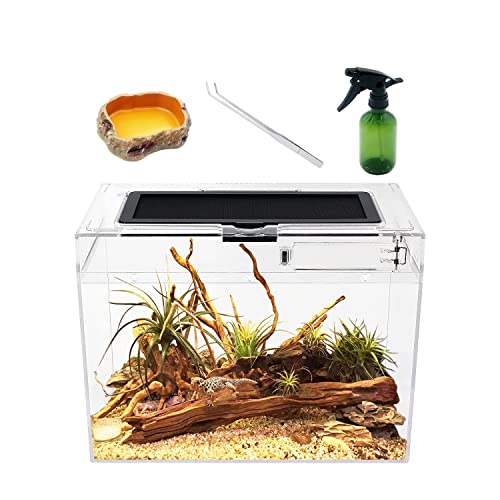
✅【Wide Application 】- The Reptile Terrariums is water tight and can hold water.Perfectly used as insect cage, small fish tank,tarantula enclosure,hermit crab tank, jumping spider enclosure, iguana cage,tortoise habitat,reptile cage ,bug cage ,bearded dragon tank,bug box,reptile carrier, reptile enclosure ,plastic terrarium,gecko tank ,plastic fish tank,lizard tank,snail terrarium,spider terrarium,hermit crab cage,frog cage, snake cage,turtle tank,frog tank,fish breeder box,bug container

✅【Suitable for Beginners】- The 6.6 Gallon Reptile Terrariums is water tight and can hold water.it comes with a long Tweezers,a feeding bowl and a spray bottle.Provide a perfect home and a warm habitat for your small reptiles, amphibians and invertebrates. Ideal for spiders, lizard, small turtles, snails, frogs, snakes, tarantulas, hermit crab or any other insects.

Multifunctional Design: This 20 gallon reptile terrarium features a multifunctional design, capable of meeting the needs of various reptiles. Whether for resting, breeding or display, it can provide your pet with an ideal living environment.


