
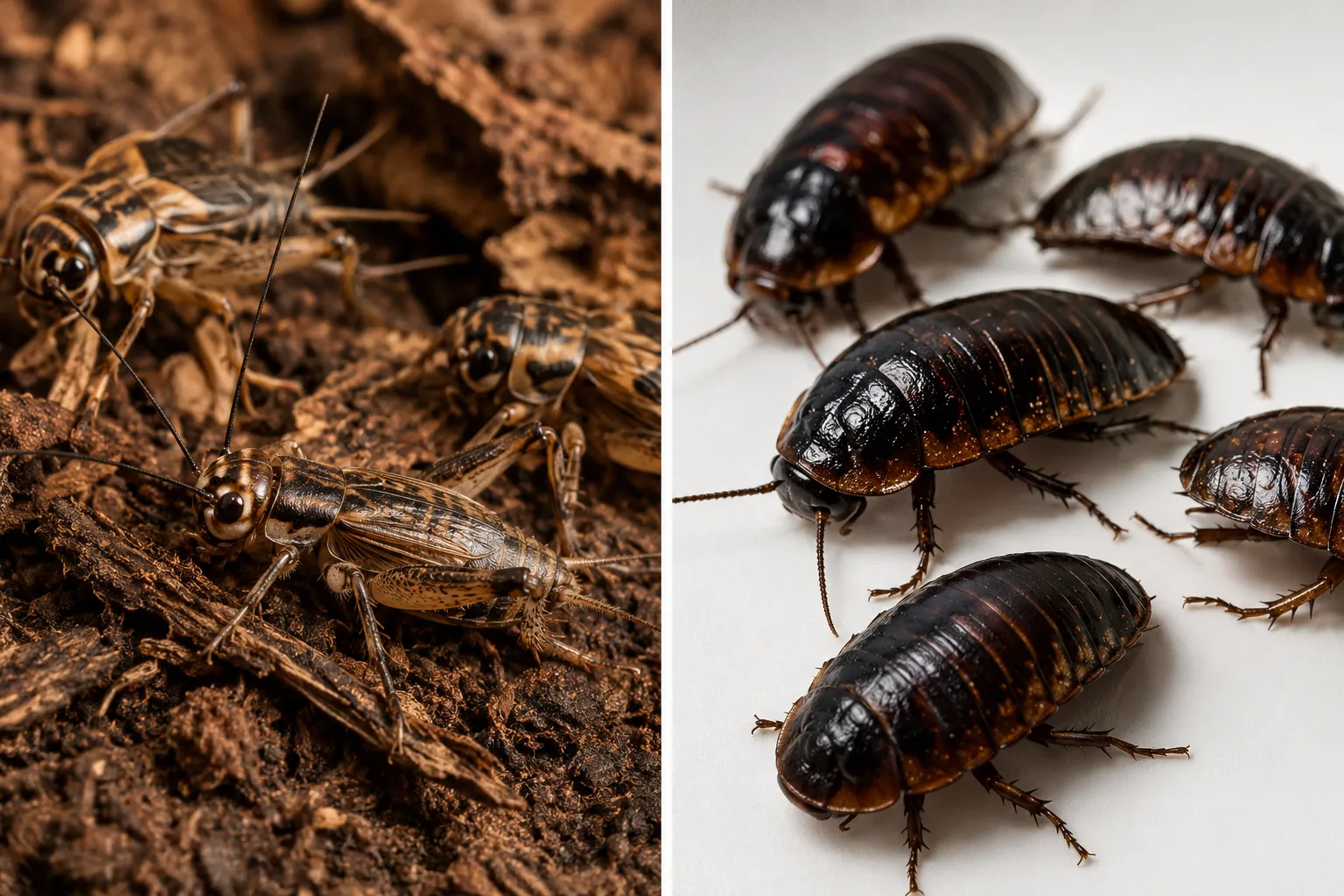
Quick Answer
Dubia roaches are generally better than crickets for most reptile owners because they live longer, smell less, contain more protein, and require less maintenance. However, crickets cost less upfront, are legal everywhere, and many reptiles prefer their movement. The best choice depends on your budget, local laws, and your pet’s preferences.

Formulated for daily feeding, this roach chow delivers balanced protein and calcium to support essential functions, healthy growth, and optimal reproduction. It’s the everyday fuel your colony needs to thrive.

All natural, preservative free food is packed with the essential nutrients and vitamins your pet needs to thrive

Key Takeaways
- Dubia roaches contain more protein (about 36% vs 21% for crickets) and less fat, making them nutritionally superior for most reptiles
- Crickets are cheaper initially but die faster, potentially costing more over time due to waste
- Dubia roaches produce almost no smell or noise, while crickets chirp constantly and create strong odors
- Crickets are legal in all states, but Dubia roaches are banned in Florida and restricted in several others
- Baby reptiles can eat both, though small crickets are often easier to source in appropriate sizes
- Dubia roaches live 5-10 times longer in storage (1-2 years vs 6-8 weeks for crickets)
- Breeding Dubia roaches at home is easier and more cost-effective than breeding crickets
- Most reptiles adapt to either feeder with patience, though some show strong preferences
- Dubia roaches don’t bite or jump, making them safer and easier to handle than crickets
- Common mistakes when switching include offering roaches that are too large or giving up too quickly when reptiles initially refuse them
What Are the Main Differences Between Crickets and Dubia Roaches as Feeder Insects?

Crickets and Dubia roaches differ significantly in nutrition, maintenance, lifespan, and behavior. Crickets are jumping insects that chirp, die quickly, and require frequent cleaning, while Dubia roaches are quiet, slow-moving, and can survive for months with minimal care.
Nutritional differences:
- Dubia roaches contain approximately 36% protein compared to crickets’ 21%
- Crickets have higher fat content, which can contribute to obesity in reptiles
- Dubia roaches offer a better calcium-to-phosphorus ratio (1:3 vs 1:9 for crickets)
- Both require gut-loading before feeding to maximize nutritional value
Behavioral and maintenance differences:
- Crickets jump, climb, and can escape easily; Dubia roaches cannot climb smooth surfaces
- Crickets produce loud chirping, especially at night; Dubia roaches are completely silent
- Cricket mortality rates are high (often 20-30% die before use); Dubia roaches rarely die in proper conditions
- Crickets cannibalize each other when crowded; Dubia roaches are less aggressive
Choose crickets if you need a budget option, live in a state where Dubia roaches are illegal, or your reptile strongly prefers fast-moving prey. Choose Dubia roaches if you want better nutrition, less maintenance, longer storage life, and a cleaner feeding setup.
Are Dubia Roaches Healthier Than Crickets for Bearded Dragons?
Yes, Dubia roaches are nutritionally superior for bearded dragons due to their higher protein content, better calcium ratio, and lower fat levels. Bearded dragons thrive on the protein-rich diet that Dubia roaches provide, and the reduced fat content helps prevent obesity, a common problem in captive bearded dragons.
Specific benefits for bearded dragons:
- The 36% protein content supports healthy growth in juveniles and muscle maintenance in adults
- Lower chitin (exoskeleton) content makes Dubia roaches easier to digest
- Reduced fat prevents fatty liver disease, which affects many pet bearded dragons
- The slower movement of Dubia roaches can reduce stress during feeding time
Common feeding approach: Many bearded dragon owners use Dubia roaches as the primary feeder and offer crickets occasionally for variety and hunting stimulation. This combination provides nutritional benefits while keeping the dragon engaged.
One important note: Some bearded dragons initially refuse Dubia roaches because they’re less active than crickets. Using feeding tongs to wiggle the roach or placing it in a shallow feeding dish usually solves this problem within a few feeding sessions.
How Much Do Crickets Cost Compared to Dubia Roaches?
Crickets cost less per insect upfront (typically $0.10-0.15 each) compared to Dubia roaches ($0.25-0.40 each), but the total cost often evens out because crickets die at much higher rates. When factoring in mortality and waste, many reptile owners find Dubia roaches more economical over time.
Price breakdown by quantity:
| Quantity | Crickets | Dubia Roaches |
|---|---|---|
| 50 count | $6-8 | $12-20 |
| 100 count | $10-15 | $25-40 |
| 500 count | $35-50 | $80-120 |
| 1000 count | $60-85 | $140-200 |
Hidden costs to consider:
- Cricket mortality can reach 30% before you use them, effectively increasing cost per feeding
- Crickets require more frequent purchases due to shorter lifespan
- Shipping costs hit harder with crickets because you need to order more often
- Dubia roaches bought in bulk can last 6-12 months, reducing shipping frequency
Money-saving tip: Breeding your own Dubia roaches becomes cost-effective after about 6 months if you feed multiple reptiles or have a large lizard. A starter colony of 50-100 roaches costs $50-100 and can produce thousands of feeders annually.
Why Do My Crickets Keep Dying But Dubia Roaches Survive Longer?
Crickets die quickly because they’re more sensitive to temperature fluctuations, humidity changes, overcrowding, and poor ventilation. Dubia roaches are hardy insects that tolerate a wider range of conditions and have significantly lower mortality rates in captivity.
Main reasons crickets die:
- Temperature stress: Crickets need consistent 75-85°F; even brief exposure to cold kills them
- Ammonia buildup: Cricket waste produces ammonia quickly, which is toxic in enclosed containers
- Cannibalism: Overcrowded crickets eat each other, especially when food or water is scarce
- Dehydration: Crickets drown easily in water dishes and dehydrate quickly without proper moisture sources
- Shipping stress: Crickets often arrive stressed and die within days of delivery
Why Dubia roaches survive better:
- They tolerate temperatures from 70-95°F without significant stress
- They produce minimal waste and almost no ammonia smell
- They’re not cannibalistic under normal conditions
- They can survive weeks without food (though this isn’t recommended)
- They handle shipping stress much better than crickets
Pro tip: If you must use crickets, buy smaller quantities more frequently rather than bulk orders. A batch of 50-100 crickets used within a week will have much lower mortality than 500 crickets stored for a month.

Do Dubia Roaches Smell Less Than Crickets?
Yes, Dubia roaches produce almost no detectable odor when kept in proper conditions, while crickets create a strong, unpleasant smell within days. The difference is dramatic enough that many reptile owners cite odor as their primary reason for switching from crickets to Dubia roaches.
Why crickets smell so bad:
- High ammonia production from their waste
- Dead crickets decompose quickly and smell terrible
- Cricket frass (droppings) accumulates rapidly
- The combination of waste, dead insects, and moisture creates a pungent odor
Why Dubia roaches stay odor-free:
- They produce dry frass with minimal ammonia
- Dead roaches are rare and don’t decompose as quickly
- They’re naturally cleaner insects with less waste production
- Proper ventilation keeps any minimal odor completely undetectable
Maintenance comparison: Cricket containers need complete cleaning every 3-4 days to control smell. Dubia roach bins can go 2-4 weeks between cleanings with no odor issues.
Common mistake: Some people report Dubia roach smell, but this almost always indicates overcrowding, excess moisture, or rotting food in the bin. A properly maintained Dubia colony should smell like nothing at all.
Which Feeder Insect Is Better for Leopard Geckos: Crickets or Dubia Roaches?
Both crickets and Dubia roaches work well for leopard geckos, but many owners prefer Dubia roaches for their superior nutrition and ease of storage. Leopard geckos readily accept both feeders, though some individuals show preferences based on movement patterns.
Dubia roach advantages for leopard geckos:
- The higher protein content supports healthy growth and tail fat storage
- Slower movement makes them easier for leopard geckos to catch
- No risk of crickets hiding in the enclosure and biting your gecko at night
- Better size variety available (nymphs for juveniles, adults for large geckos)
Cricket advantages for leopard geckos:
- The fast, erratic movement triggers strong hunting responses
- Easier to find in small sizes for baby leopard geckos
- Lower initial cost for new gecko owners testing feeding preferences
- Available at virtually every pet store
Feeding strategy: Offer appropriately sized feeders (no larger than the space between your gecko’s eyes). For adult leopard geckos, medium Dubia roaches or adult crickets work well. Juveniles need small nymphs or pinhead crickets.
Watch out for: Crickets left in the enclosure overnight can bite leopard geckos, especially around the toes and tail. Always remove uneaten crickets after 15-20 minutes. Dubia roaches don’t pose this risk and can be left safely.
Can Baby Reptiles Eat Dubia Roaches or Should I Stick With Crickets?
Baby reptiles can absolutely eat Dubia roaches as long as you choose appropriately sized nymphs. Small Dubia roach nymphs are actually safer than crickets for hatchlings because they don’t bite, are easier to digest, and provide better nutrition for rapid growth.
Size guidelines for baby reptiles:
- Feeders should be no larger than the space between the reptile’s eyes
- For tiny hatchlings (baby leopard geckos, small bearded dragons), use 1/8-inch Dubia nymphs
- For slightly larger juveniles, 1/4-inch nymphs work well
- Pinhead and small crickets are alternatives but offer less nutrition
Benefits of Dubia roaches for babies:
- Higher protein supports faster, healthier growth
- Softer exoskeleton is easier for small reptiles to digest
- No risk of biting vulnerable hatchlings
- Less likely to escape and hide in the enclosure
Availability challenge: Small Dubia nymphs can be harder to source than pinhead crickets. Many online feeder suppliers offer mixed-size Dubia roach colonies, but you may need to sort through them to find appropriately sized nymphs.
Best practice: Many breeders start hatchlings on small Dubia roaches and supplement with fruit flies or small crickets for variety. This approach provides optimal nutrition while keeping babies engaged with different prey movements.
What Are the Best Alternatives to Crickets and Dubia Roaches for Feeding Reptiles?
Several excellent alternatives exist beyond crickets and Dubia roaches, including black soldier fly larvae, hornworms, superworms, silkworms, and other roach species. Each offers unique nutritional benefits and can add valuable variety to your reptile’s diet.
Top alternatives:
Black soldier fly larvae (BSFL/Calciworms):
- Excellent natural calcium source (no dusting required)
- Long shelf life and low maintenance
- Great for reptiles that need extra calcium
- Lower protein than roaches, best used as supplements
Hornworms:
- High moisture content (good for hydration)
- Low in fat, high in calcium
- Expensive and grow very quickly
- Best as occasional treats rather than staples
Superworms:
- High fat content (good for underweight reptiles)
- Long storage life
- Can bite, so use with caution
- Not suitable as primary feeders due to high fat
Silkworms:
- Extremely nutritious with excellent protein
- Low in fat, easy to digest
- Expensive and require specific care
- Difficult to source consistently
Other roach species:
- Red runner roaches (legal in more states than Dubias)
- Discoid roaches (similar to Dubias, legal everywhere)
- Orange head roaches (larger option for big reptiles)
Variety strategy: Most experienced reptile keepers use 2-3 different feeder types regularly. A common rotation might be Dubia roaches as the staple (70% of diet), crickets for hunting enrichment (20%), and BSFL or hornworms as treats (10%).

Formulated to be easily digested by all feeder insects
All natural, preservative free food is packed with the essential nutrients and vitamins your pet needs to thrive

Formulated to be easily digested by all feeder insects
Do Dubia Roaches Bite or Are They Safer to Handle Than Crickets?
Dubia roaches do not bite humans or reptiles and are significantly safer to handle than crickets. They lack the mouthparts to break human skin and show no aggressive behavior, while crickets can and do bite both handlers and reptiles.
Safety comparison:
- Dubia roaches: Cannot bite, don’t jump, can’t climb smooth surfaces, completely docile
- Crickets: Can bite (painful pinch), jump erratically, climb easily, may bite reptiles overnight
Handling characteristics:
- Dubia roaches move slowly and are easy to pick up or transfer with tongs
- They don’t scatter when you open their container
- No risk of them jumping onto you or around your room
- They can’t infest your home even if a few escape (they need specific conditions to breed)
Cricket handling challenges:
- They jump unpredictably when you open the container
- Fast movement makes them hard to catch
- They can establish populations in warm areas of your home if they escape
- Their bites, while not dangerous, are annoying and can startle you
For children: Dubia roaches are much more appropriate if kids help with reptile care. They’re calm, predictable, and won’t cause the squealing chaos that often happens when crickets escape during feeding time.
Common Mistakes When Switching From Crickets to Dubia Roaches
The most common mistake when switching from crickets to Dubia roaches is giving up too quickly when reptiles initially refuse them. Most reptiles need 3-7 feeding attempts to accept a new feeder type, and owners often return to crickets after just one or two refusals.
Top mistakes and solutions:
Offering roaches that are too large:
- Mistake: Using adult roaches for reptiles accustomed to medium crickets
- Solution: Start with smaller Dubia nymphs, even if your reptile can handle larger prey
Not creating enough movement:
- Mistake: Placing still roaches in a bowl and expecting immediate interest
- Solution: Use feeding tongs to wiggle the roach, mimicking cricket movement
Switching too abruptly:
- Mistake: Going from 100% crickets to 100% roaches overnight
- Solution: Mix both feeders, gradually increasing the roach ratio over 2-3 weeks
Feeding when the reptile isn’t hungry:
- Mistake: Trying to introduce new feeders when your reptile recently ate
- Solution: Wait until your reptile is actively hunting, then offer roaches
Not gut-loading properly:
- Mistake: Assuming roaches are nutritious without preparation
- Solution: Gut-load roaches for 24-48 hours before feeding, just like crickets
Giving up on picky eaters:
- Mistake: Assuming your reptile will never accept roaches after a few refusals
- Solution: Be patient; some reptiles take 10+ attempts but eventually accept them
Pro strategy: For extremely stubborn reptiles, try crushing the roach’s head (sounds harsh, but it works) to release scent and fluids that trigger feeding responses. This technique often works when nothing else does.
Are Dubia Roaches Illegal in My State?
Dubia roaches are illegal in Florida and restricted or require permits in several other states due to concerns about them establishing wild populations. Before purchasing Dubia roaches, check your state and local regulations, as penalties for possession can include fines.
States with restrictions:
- Florida: Complete ban on possession, sale, and transport
- Hawaii: Banned (strict regulations on all non-native species)
- Louisiana: Restricted; check current regulations before purchasing
Why the restrictions exist:
- Concerns about tropical roach species establishing populations in warm climates
- Florida’s climate is particularly suitable for Dubia roach survival
- Agricultural and ecosystem protection concerns
Legal alternatives in restricted states:
- Discoid roaches (legal everywhere, similar nutrition to Dubias)
- Red runner roaches (legal in most states, check locally)
- Orange head roaches (legal in most areas)
- Traditional crickets (legal everywhere)
Verification tip: Even if your state isn’t listed above, check with your state’s Department of Agriculture or local exotic pet regulations. Laws change, and some counties have restrictions even when states don’t.
Responsible ownership: Never release Dubia roaches (or any feeder insects) into the wild, regardless of legality. This can disrupt local ecosystems and contribute to the spread of invasive species.
How Long Do Dubia Roaches Live Compared to Crickets in Storage?
Dubia roaches live 1-2 years in proper storage conditions, while crickets typically survive only 6-8 weeks, making roaches far superior for long-term storage and reducing the frequency of feeder purchases. This dramatic difference in lifespan is one of the biggest practical advantages of Dubia roaches.
Lifespan comparison:
- Dubia roaches: 1-2 years (females live longer than males)
- Crickets: 6-8 weeks maximum, often less
- Dubia nymphs: Can be stored at cooler temperatures to slow growth for months
- Cricket nymphs: Still die quickly regardless of size
Storage conditions for maximum lifespan:
Dubia roaches:
- Temperature: 75-85°F (lower temps slow reproduction and growth)
- Humidity: 40-60% (too high causes mold, too low causes dehydration)
- Food: Fresh vegetables, roach chow, or dry dog food
- Water: Water crystals or gel (prevents drowning)
- Cleaning: Every 2-4 weeks
Crickets:
- Temperature: 75-85°F (very sensitive to fluctuations)
- Humidity: 50-70% (difficult to maintain)
- Food: Cricket food, vegetables (remove uneaten food quickly)
- Water: Sponge or crystals (they drown easily)
- Cleaning: Every 3-4 days (critical for survival)
Economic impact: The extended lifespan means you can buy Dubia roaches in bulk (500-1000 count) and use them over many months, dramatically reducing per-feeding costs and shipping expenses.
Which Is Easier to Breed at Home: Crickets or Dubia Roaches?
Dubia roaches are significantly easier to breed at home than crickets, requiring less space, producing less noise and odor, and having much higher success rates for beginners. A Dubia roach colony can become self-sustaining within 6-8 months with minimal intervention.
Why Dubia roaches are easier to breed:
- Simple setup: Just a plastic bin, egg crates, heat source, and food
- Low maintenance: Clean every 3-4 weeks, add food and water as needed
- No noise: Completely silent breeding colony
- Minimal smell: Properly maintained colonies have no odor
- High success rate: Colonies grow reliably with basic care
- Long-lived breeders: Adult roaches breed for 1-2 years
Cricket breeding challenges:
- Complex setup: Requires separate bins for adults, eggs, and nymphs
- High maintenance: Daily monitoring, frequent cleaning
- Loud chirping: Male crickets chirp constantly (very annoying indoors)
- Strong odor: Cricket colonies smell bad even with frequent cleaning
- High mortality: Cannibalism and disease kill many crickets
- Short breeding window: Adults live only weeks
Basic Dubia roach colony setup:
- Container: 18-gallon plastic bin with ventilation holes
- Substrate: None needed (bare bottom is easier to clean)
- Hiding spots: Egg crate flats stacked vertically
- Heat: Heat mat or ceramic heater to maintain 85-95°F
- Food: Fresh vegetables, dry food (roach chow or dog food)
- Water: Water crystals or gel
- Starter colony: 20-30 adult females, 5-10 adult males, 50+ nymphs
Timeline to self-sustaining colony: With proper care, you can start harvesting feeders at 4-6 months and achieve full self-sustainability (harvesting equals reproduction rate) at 6-12 months.
Cost analysis: A starter colony costs $50-100. After 6 months, you’ll have hundreds of roaches. After a year, you’ll have thousands, potentially saving $500-1000 annually if you feed multiple reptiles.
Crickets vs Dubia Roaches: Which Is Better for Your Specific Situation?
The better choice between crickets and Dubia roaches depends on your location, budget, reptile species, and personal preferences regarding maintenance and storage. Neither is universally superior; the right answer varies by individual circumstances.
Choose Dubia roaches if:
- You want the most nutritious feeder with high protein and low fat
- You prefer minimal maintenance, odor, and noise
- You’re willing to pay more upfront for long-term savings
- You have space for bulk storage or breeding
- Your state allows Dubia roach ownership
- You feed multiple reptiles or large species
- You value convenience and longer storage life
Choose crickets if:
- You live in Florida, Hawaii, or other restricted areas
- You need the lowest upfront cost
- Your reptile strongly prefers fast-moving prey
- You want feeders available at any local pet store
- You feed only one small reptile occasionally
- You’re testing whether your new reptile will eat insects
- Your reptile is extremely picky and refuses roaches
Best of both worlds approach:
Many experienced reptile keepers use Dubia roaches as the primary staple (70-80% of feedings) and offer crickets occasionally for hunting enrichment and dietary variety. This strategy provides optimal nutrition while keeping reptiles mentally stimulated.
For beginners: Start with small quantities of both feeders to determine what your specific reptile prefers. Some individuals have strong preferences that override general recommendations. A bearded dragon that refuses Dubia roaches but eagerly hunts crickets should get crickets, regardless of nutritional superiority.
For advanced keepers: Consider breeding Dubia roaches and supplementing with purchased crickets, hornworms, or BSFL for variety. This approach minimizes costs while maximizing nutrition and enrichment.
Frequently Asked Questions
Can I feed my reptile only Dubia roaches?
Yes, Dubia roaches can serve as a complete staple feeder for most insectivorous reptiles when properly gut-loaded and dusted with calcium and vitamins. However, offering variety with other feeders provides enrichment and ensures balanced nutrition.
How many Dubia roaches should I feed my bearded dragon?
Adult bearded dragons typically eat 5-10 appropriately sized Dubia roaches per feeding, 2-3 times per week. Juveniles need 10-20 smaller roaches daily. Adjust based on your dragon’s size, age, and body condition.
Will Dubia roaches infest my house if they escape?
No, Dubia roaches cannot establish populations in typical homes because they require temperatures above 80°F and high humidity to breed. Escaped roaches will simply hide and eventually die without reproducing.
Why won’t my leopard gecko eat Dubia roaches?
Leopard geckos often refuse Dubia roaches initially because they move slower than crickets. Try wiggling the roach with tongs, offering smaller nymphs, or waiting until your gecko is very hungry. Most geckos accept them within 5-10 attempts.
Can I keep crickets and Dubia roaches in the same container?
No, never house different feeder species together. They have different care requirements, and crickets may bite or stress the roaches. Keep them in separate containers with species-appropriate conditions.
Do Dubia roaches need a heat source?
Dubia roaches survive at room temperature (70-75°F) but breed and grow best at 85-95°F. If you’re just storing them for feeding, room temperature works fine. For breeding colonies, supplemental heat is essential.
How do I gut-load Dubia roaches?
Feed your Dubia roaches nutritious foods 24-48 hours before offering them to your reptile. Good options include leafy greens, carrots, sweet potato, squash, and commercial gut-load products. Remove uneaten fresh food after 24 hours to prevent mold.
Are Dubia roaches better than mealworms?
Yes, Dubia roaches are nutritionally superior to mealworms, offering more protein, less fat, better calcium ratios, and easier digestion. Mealworms should be occasional treats, while Dubia roaches can be a dietary staple.
Can baby bearded dragons eat adult Dubia roaches?
No, baby bearded dragons should only eat appropriately sized feeders (no larger than the space between their eyes). Offer small Dubia nymphs (1/4 inch or smaller) to hatchlings and juveniles.
How do I store Dubia roaches long-term?
Keep Dubia roaches in a ventilated plastic container with egg crate hiding spots, at 70-85°F, with access to dry food and water crystals. Clean the container every 2-4 weeks. They’ll live 1-2 years with proper care.
Do Dubia roaches carry parasites?
Captive-bred Dubia roaches from reputable suppliers are extremely unlikely to carry parasites harmful to reptiles. They’re much cleaner than wild-caught insects and pose minimal disease risk when sourced properly.
Can I feed dead Dubia roaches to my reptile?
Most reptiles prefer live prey and may refuse dead insects. However, some species (like certain geckos) will accept freshly killed roaches. Never feed insects that died from unknown causes or have been dead for more than a few hours.
Conclusion
When comparing crickets vs Dubia roaches to determine which is better, Dubia roaches emerge as the superior choice for most reptile owners due to their exceptional nutrition, minimal maintenance, longer lifespan, and complete lack of odor or noise. They contain significantly more protein, live up to two years in storage, and require cleaning only every few weeks compared to crickets’ constant care demands.
However, crickets remain valuable for their lower upfront cost, universal legal status, and availability at any pet store. They’re particularly useful for owners in states where Dubia roaches are banned, those feeding reptiles that strongly prefer fast-moving prey, or beginners testing their new pet’s feeding preferences.
Take action now:
- Check your local laws to confirm Dubia roaches are legal in your area
- Order a small quantity of both feeders to test your reptile’s preferences
- Start with a 70/30 mix of Dubia roaches to crickets, adjusting based on your pet’s response
- Consider starting a breeding colony if you feed multiple reptiles or plan long-term ownership
- Always gut-load and dust whichever feeder you choose for optimal reptile health
The best feeder insect is ultimately the one your reptile will eat consistently while meeting their nutritional needs. Most reptiles adapt to Dubia roaches within a few weeks, making them the smart long-term choice for healthier pets and easier care routines.

Blend of dried mealworms, river shrimp and Crickets

Bugs & Nuts for Healthy Birds — This bird food blend combines coarse sunflower chips, tree nuts, and shelled peanuts for a balanced diet, along with mealworms, cranberries, and papaya for added nutrition. A no-mess, high-protein wild bird seed that supports strong beaks, feathers, and energy.


