
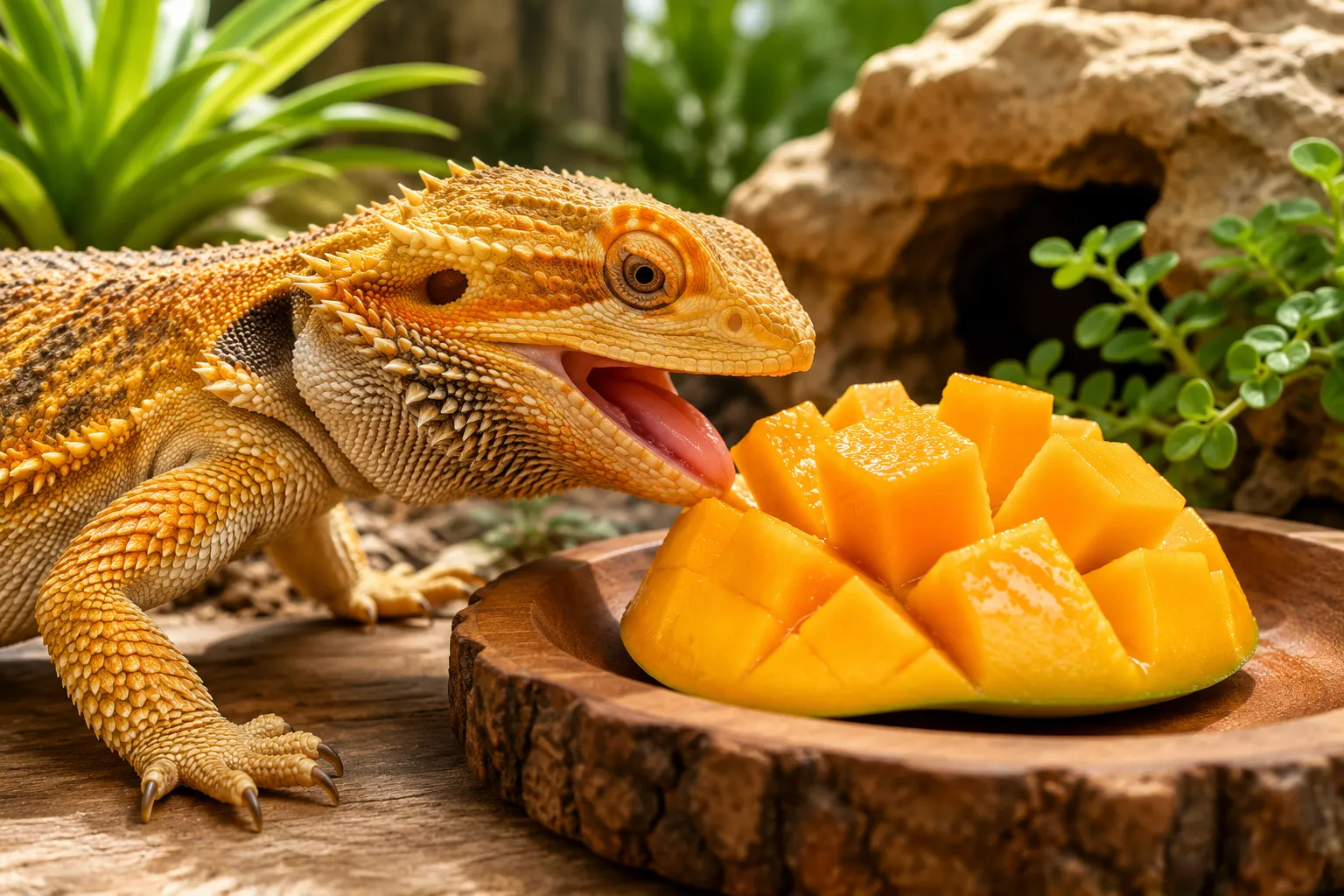
Quick Answer: Yes, bearded dragons can eat mango safely, but only as an occasional treat. Mango should be fed in small amounts (a few bite-sized pieces) no more than once or twice per month due to its high sugar content and unfavorable calcium-to-phosphorus ratio. Always remove the skin and pit, and cut the flesh into small, manageable pieces before offering it to your dragon.
Key Takeaways
- Mango is safe for bearded dragons but should only be given as an occasional treat (1-2 times per month maximum)
- The high sugar content in mango can lead to obesity, digestive issues, and other health problems if fed too frequently
- Always remove the skin and pit completely before feeding mango to your bearded dragon
- Cut mango into small, bite-sized pieces appropriate for your dragon’s size to prevent choking
- Baby bearded dragons should avoid mango entirely and focus on protein and nutrient-dense greens
- Fresh mango is the only safe option, dried mango contains concentrated sugars and is not recommended
- Better fruit alternatives include papaya, figs, and berries, which offer more balanced nutrition
- Mango has a poor calcium-to-phosphorus ratio (roughly 1:1), which can interfere with calcium absorption
- Most bearded dragons enjoy mango, but some may refuse it, which is completely normal
- Fruits should make up only 5-10% of an adult bearded dragon’s total diet

Vitamin Enriched Formula That Provides Essential Proteins, Fats, Vitamins And Minerals

All Natural: 100% all-natural and preservative-free

All without the hassle of dealing with live Prey items
Is Mango Safe for Bearded Dragons to Eat?
Yes, mango is safe for bearded dragons when prepared properly and fed in moderation. The flesh of ripe mango contains no toxic compounds and provides vitamins A and C, which support immune function and eye health. However, mango comes with nutritional trade-offs that make it less ideal than other food options.
The main concern with mango is its high sugar content, approximately 14-15 grams of sugar per 100 grams of fruit. Bearded dragons evolved in arid Australian environments where sugary fruits were scarce, so their digestive systems aren’t designed to process large amounts of sugar regularly. Additionally, mango has a calcium-to-phosphorus ratio of roughly 1:1, which is far from the ideal 2:1 ratio bearded dragons need for proper bone health.
When mango is safe:
- Fed once or twice per month maximum
- Given in small portions (2-3 small cubes for an adult dragon)
- Properly prepared with skin and pit completely removed
- Offered to healthy adult dragons (not babies or juveniles)
Common mistake to avoid: Many new bearded dragon owners see their pet eagerly eating mango and assume it’s healthy to feed regularly. Just because your dragon loves it doesn’t mean it should be a frequent food, think of mango like candy for reptiles.
How Much Mango Can I Feed My Bearded Dragon?

An adult bearded dragon should receive no more than 2-3 small cubes of mango (roughly the size of your dragon’s eye) per feeding session. This small portion size helps prevent sugar overload while still allowing your pet to enjoy the treat.
The appropriate serving size depends on your dragon’s age and size:
Adult bearded dragons (18+ months):
- 2-3 cubes approximately 1 cm each
- Total volume should not exceed one teaspoon
- Mixed with other foods rather than fed alone
Juvenile bearded dragons (6-18 months):
- 1-2 very small pieces if offered at all
- Better to skip mango entirely during this growth phase
- Focus on protein and calcium-rich foods instead
Baby bearded dragons (0-6 months):
- Zero mango recommended
- Babies need maximum nutrition for rapid growth
- Stick to insects and nutrient-dense greens
Choose this portion size if your dragon is healthy, active, and already eating a balanced diet of appropriate staple greens and insects. If your dragon is overweight, recovering from illness, or has metabolic bone disease, skip mango entirely until health improves.
How Often Can Bearded Dragons Have Mango?
Bearded dragons should eat mango no more than once or twice per month. This infrequent schedule prevents the negative effects of excess sugar while still providing occasional dietary variety and enrichment.
Mango falls into the “rare treat” category of bearded dragon foods, similar to grapes and bananas. The high sugar content means frequent feeding can lead to:
- Weight gain and obesity, excess sugar converts to fat storage
- Digestive upset, diarrhea or loose stools from too much fruit
- Nutritional imbalance, displacing more nutritious foods from the diet
- Calcium absorption issues, the phosphorus in mango binds with calcium
Feeding schedule recommendation:
- Week 1-3: No mango, focus on staple greens and appropriate insects
- Week 4: Offer 2-3 small mango cubes as a treat
- Repeat cycle
If you want to offer fruit more frequently, rotate between different options. For example, offer mango one week, then wait two weeks and offer papaya, then wait another two weeks before offering berries. This rotation prevents any single fruit from being overfed while providing variety.
Edge case: If your bearded dragon is refusing to eat due to stress or illness, a tiny piece of mango can sometimes stimulate appetite. In this situation, consult with a reptile veterinarian before using fruit as an appetite stimulant.
Do I Need to Peel Mango Before Giving It to My Bearded Dragon?
Yes, you must always peel mango completely before feeding it to your bearded dragon. Mango skin is tough, difficult to digest, and may contain pesticide residues that can harm your pet. The skin also presents a choking hazard and can cause intestinal blockages.
Proper mango preparation steps:
- Wash the mango thoroughly under running water, even though you’ll remove the skin
- Peel completely using a vegetable peeler or sharp knife, removing all skin
- Remove the pit entirely, the large flat seed in the center is a choking hazard and contains compounds that may be harmful
- Cut into small cubes appropriate for your dragon’s size (roughly eye-sized pieces)
- Rinse the cubes one final time to remove any remaining skin fragments
- Serve immediately or refrigerate in an airtight container for up to 24 hours
The flesh should be ripe but firm, overripe, mushy mango is harder for dragons to eat and may cause more digestive upset. If the mango is stringy or fibrous, cut away those sections and only offer the smooth flesh.
Safety tip: Never leave mango pieces in your dragon’s enclosure for more than 2-3 hours. Fruit spoils quickly under heat lamps and can grow harmful bacteria. Remove any uneaten pieces promptly.

What Fruits Are Better Than Mango for Bearded Dragons?
Several fruits offer better nutritional profiles than mango for bearded dragons, including papaya, figs, and certain berries. These alternatives provide vitamins and minerals with lower sugar content or better calcium-to-phosphorus ratios.
Top fruit alternatives to mango:
Papaya, The best fruit option for bearded dragons. Contains digestive enzymes, has a better calcium-to-phosphorus ratio than mango, and is rich in vitamin A. Can be fed slightly more often than mango (2-3 times per month).
Figs, Excellent calcium content (roughly 3:1 calcium-to-phosphorus ratio), making them one of the few fruits that actually support bone health. Feed fresh figs 2-3 times per month.
Blueberries, Lower in sugar than mango, high in antioxidants, and small enough to feed whole to adult dragons. Offer 2-4 berries once or twice per month.
Strawberries, Good vitamin C content and moderate sugar levels. Remove the green tops and cut into quarters. Feed 1-2 times per month.
Blackberries and raspberries, Lower sugar than mango with beneficial fiber. Feed whole or halved depending on dragon size, 1-2 times per month.
Fruits to avoid entirely:
- Avocado (toxic to bearded dragons)
- Rhubarb (toxic)
- Citrus fruits (too acidic, can cause digestive upset)
Remember that even the “better” fruits should still make up only a small portion of your dragon’s diet. The bulk of plant matter should come from staple greens like collard greens, mustard greens, turnip greens, and dandelion greens.
Can Baby Bearded Dragons Eat Mango?
No, baby bearded dragons should not eat mango. Babies (0-6 months old) require a diet focused almost entirely on protein from appropriately-sized insects and calcium-rich greens to support their rapid growth and bone development. Mango provides minimal nutritional value for growing dragons and takes up valuable stomach space that should be filled with more nutritious foods.
Baby bearded dragons need a diet consisting of approximately 80% protein (small crickets, dubia roaches, black soldier fly larvae) and 20% vegetables (finely chopped nutrient-dense greens). Their small digestive systems and high metabolic demands mean every meal must be nutritionally dense.
Why mango is inappropriate for baby dragons:
- High sugar content provides empty calories without supporting growth
- Poor calcium-to-phosphorus ratio interferes with bone development
- Takes up stomach space that should contain protein and calcium
- Can cause digestive upset in sensitive young dragons
- May create preference for sweet foods over nutritious staples
When can young dragons start eating mango? Wait until your bearded dragon reaches at least 12-18 months old before introducing any fruit, including mango. Even then, start with just one small piece to test tolerance, and maintain the once-or-twice-monthly feeding schedule.
Juvenile dragons (6-18 months) can occasionally have a tiny taste of mango, but it should be extremely rare and only after they’re consistently eating their staple greens and insects. If a juvenile dragon shows any signs of preferring fruit over greens, eliminate fruit entirely until eating habits normalize.
Mango vs Papaya for Bearded Dragons: Which Is Healthier?
Papaya is healthier than mango for bearded dragons due to its superior calcium-to-phosphorus ratio, digestive enzymes, and slightly lower sugar content. While both fruits should be fed sparingly, papaya offers more nutritional benefits with fewer drawbacks.
Nutritional comparison:
| Nutrient Factor | Mango | Papaya |
|---|---|---|
| Sugar content | ~15g per 100g | ~9g per 100g |
| Calcium:Phosphorus ratio | ~1:1 (poor) | ~2:1 (good) |
| Vitamin A | High | Very high |
| Digestive enzymes | Minimal | Papain (beneficial) |
| Recommended frequency | 1-2x per month | 2-3x per month |
Choose papaya if: You want to offer fruit slightly more frequently, your dragon needs digestive support, or you’re looking for the single best fruit option for regular rotation.
Choose mango if: Your dragon refuses papaya, you already have ripe mango available, or you’re offering fruit very infrequently (once per month or less) and the nutritional difference is negligible.
Best practice: Rotate between both fruits along with other options like figs and berries. This variety prevents over-reliance on any single fruit while providing different vitamins and minerals. For example, offer papaya one month, mango the next, then figs the following month.
Both fruits should still be prepared the same way, peeled, pit removed, and cut into small pieces, and neither should ever become a dietary staple.
What Happens If My Bearded Dragon Eats Too Much Mango?
If a bearded dragon eats too much mango in one sitting, the most common immediate effect is diarrhea or loose, watery stools within 6-24 hours. The excess sugar and fruit fiber overwhelm the digestive system, leading to rapid transit through the intestines and poor nutrient absorption.
Short-term effects of mango overconsumption:
- Diarrhea or very loose stools
- Increased thirst and urination
- Lethargy or reduced activity
- Loss of appetite for regular foods
- Possible stomach discomfort (visible as unusual postures or restlessness)
Long-term effects of frequent mango feeding:
- Obesity, excess sugar converts to fat, leading to overweight dragons
- Metabolic bone disease, poor calcium absorption from unfavorable phosphorus levels
- Fatty liver disease, chronic sugar overload damages liver function
- Nutritional deficiencies, fruit displaces nutrient-dense foods from the diet
- Dental problems, sugar can contribute to mouth issues
- Picky eating habits, dragons may refuse healthy foods in favor of sweet treats
What to do if your dragon ate too much mango:
- Remove all remaining mango from the enclosure immediately
- Provide fresh water to prevent dehydration from diarrhea
- Skip the next meal or offer only a small amount of greens to let the digestive system recover
- Monitor stools for 24-48 hours, they should return to normal consistency
- Return to normal diet gradually, starting with staple greens and appropriately-sized insects
- Contact a reptile vet if diarrhea persists beyond 48 hours, if your dragon becomes lethargic, or if you notice signs of dehydration (sunken eyes, wrinkled skin)
Most healthy adult dragons will recover from a one-time mango overindulgence within 1-2 days. However, repeated overconsumption can cause serious long-term health issues that require veterinary intervention.

✔ HEALTHY - This nutritious blend includes figs, papaya, green beans, cabbage, squash, apple and carrots

Freeze-dried Fresh Fruit: Amilutuo freeze-dried dragon fruit is made using freeze-drying technology, which retains the fresh taste and natural nutrients of the fruit, making it both refreshing and satisfying.

Quick and Easy Preparation: Simply add water to our Fruit Mix Instant Meal for a hassle-free, nutritious option. Ideal for tortoise habitat accessories and tortoise food, it rehydrates in minutes, making it perfect for baby turtle food and box turtle food.
Can Bearded Dragons Eat Dried Mango or Just Fresh?
Bearded dragons should only eat fresh mango, dried mango is not recommended. The dehydration process concentrates the sugar content to dangerous levels, often tripling or quadrupling the sugar density compared to fresh fruit. Many commercial dried mangos also contain added sugars, sulfites, and preservatives that can harm reptiles.
Why dried mango is problematic:
- Concentrated sugar, dried mango can contain 60-70g of sugar per 100g (compared to 15g in fresh)
- Additives, sulfur dioxide, added sugars, and artificial preservatives are common
- Choking hazard, dried fruit is sticky and chewy, making it difficult for dragons to swallow
- Dental issues, sticky dried fruit can adhere to teeth and mouth tissues
- Rehydration problems, dried fruit expands in the stomach, potentially causing blockages
Other dried fruits to avoid:
- Dried papaya
- Raisins
- Dried cranberries
- Dried apricots
- Any “candied” or sugar-coated dried fruit
The only exception: If you’re in an emergency situation with no access to fresh food, you could rehydrate a small piece of unsweetened, preservative-free dried mango in water for several hours until it returns to near-fresh consistency. However, this should only be a last resort, and fresh mango or other fresh fruits are always preferable.
Stick to fresh, ripe mango that you prepare yourself. This gives you complete control over what your dragon consumes and ensures the safest, most nutritious treat possible.
Why Is Mango High in Sugar Bad for Bearded Dragons?
Mango’s high sugar content is problematic for bearded dragons because their digestive systems evolved to process a diet low in simple sugars, primarily consisting of insects, desert plants, and occasional flowers. Excess sugar leads to metabolic stress, weight gain, and long-term health complications.
How sugar affects bearded dragon health:
Metabolic disruption, Bearded dragons have relatively simple digestive systems compared to mammals. Large amounts of sugar cause blood glucose spikes that their bodies struggle to regulate efficiently, potentially leading to insulin resistance over time.
Fat accumulation, Unused sugar converts to fat and stores in the liver and throughout the body. Overweight bearded dragons face reduced mobility, organ stress, and shorter lifespans.
Gut flora imbalance, Excess sugar feeds harmful bacteria in the digestive tract while suppressing beneficial microorganisms. This imbalance can cause chronic digestive issues and reduced nutrient absorption.
Calcium interference, High sugar intake can indirectly affect calcium metabolism by altering gut pH and reducing the efficiency of calcium absorption from other foods.
Behavioral changes, Some dragons become “addicted” to sweet foods and refuse to eat their nutritious staple greens, leading to severe nutritional deficiencies.
Natural diet context: In their native Australian habitat, bearded dragons encounter very few sugary foods. Their diet consists mainly of insects, succulent plants, flowers, and occasional native fruits that are far less sweet than cultivated tropical fruits like mango. Their bodies simply aren’t designed to process regular sugar loads.
The bottom line: Sugar isn’t toxic to bearded dragons in small amounts, but it provides no essential nutrients they can’t get from better sources. Every bite of sugary fruit is a missed opportunity to feed something more nutritious like collard greens, dubia roaches, or calcium-dusted insects.
What Are the Best Fruits for Bearded Dragons’ Daily Diet?
No fruit should be part of a bearded dragon’s daily diet, this is a critical misconception to correct. Fruits of any kind should only be offered occasionally as treats, making up no more than 5-10% of the total plant matter in an adult dragon’s diet, which itself should be only 20-30% of their overall food intake.
The ideal bearded dragon diet structure:
Adult dragons (18+ months):
- 70-80% plant matter (mostly staple greens)
- 20-30% insects
- Fruits: occasional treats only (1-2 times per month)
Juvenile dragons (6-18 months):
- 50% plant matter (mostly staple greens)
- 50% insects
- Fruits: rare to never
Baby dragons (0-6 months):
- 20% plant matter (finely chopped greens)
- 80% insects
- Fruits: never
Best staple greens for daily feeding:
- Collard greens
- Mustard greens
- Turnip greens
- Dandelion greens
- Endive
- Escarole
- Watercress
- Bok choy
Best occasional vegetables (2-3 times per week):
- Butternut squash
- Acorn squash
- Bell peppers
- Snap peas
- Okra
Best fruits for occasional treats (1-2 times per month):
- Papaya
- Figs
- Blueberries
- Strawberries
- Blackberries
- Mango (sparingly)
The foundation of a healthy bearded dragon diet is variety in staple greens, appropriately-sized insects dusted with calcium powder, and proper supplementation. Fruit is purely for enrichment and variety, not nutrition. If you’re looking to improve your dragon’s daily diet, focus on rotating different staple greens rather than adding more fruit.
My Bearded Dragon Won’t Eat Mango, Is That Normal?
Yes, it’s completely normal for a bearded dragon to refuse mango or show no interest in it. Individual dragons have distinct food preferences, and not all dragons enjoy sweet fruits. Some dragons prefer vegetables, others favor certain insects, and some are simply picky eaters.
Common reasons dragons refuse mango:
Natural preference variation, Just like humans, bearded dragons have individual tastes. Some dragons love mango, others ignore it completely. This variation is normal and healthy.
Texture sensitivity, Some dragons dislike the slippery, soft texture of mango and prefer crunchier foods like bell peppers or firmer fruits like apple (which should also be fed sparingly).
Unfamiliarity, Dragons can be hesitant about new foods. If your dragon has never encountered mango before, it may take several exposures before they’re willing to try it.
Already satiated, If you offer mango after your dragon has eaten a full meal, they may simply be too full to be interested in treats.
Health issues, Loss of appetite for all foods (not just mango) can indicate illness, stress, or improper husbandry. If your dragon refuses all food for more than a few days, consult a reptile veterinarian.
What to do if your dragon refuses mango:
Don’t force it. There’s no nutritional reason your dragon needs to eat mango specifically. Simply offer other treat options like papaya, berries, or small amounts of other fruits. Focus your energy on ensuring your dragon consistently eats their staple greens and insects, which are far more important for health.
When refusal is actually beneficial: If your dragon refuses mango but eagerly eats their greens and insects, that’s ideal. You have a dragon with healthy food priorities who isn’t tempted by sugary treats, this makes maintaining proper nutrition easier.
Can Bearded Dragons Eat Mango Skin and Pit?
No, bearded dragons should never eat mango skin or pit. Both parts of the mango present serious health risks and must be completely removed before offering any mango flesh to your dragon.
Dangers of mango skin:
Pesticide residues, Mango skin absorbs and retains pesticides, fungicides, and other agricultural chemicals that can be toxic to reptiles even in small amounts.
Digestive obstruction, The tough, fibrous skin is extremely difficult for bearded dragons to digest and can cause impaction (intestinal blockage), a life-threatening condition.
Choking hazard, Large pieces of skin can get stuck in the throat or esophagus.
Urushiol content, Mango skin contains urushiol, the same compound found in poison ivy. While most bearded dragons won’t have an allergic reaction, it can cause mouth irritation in sensitive individuals.
Dangers of mango pit:
Choking and obstruction, The large, flat pit is a severe choking hazard and can cause complete intestinal blockage if swallowed.
Toxic compounds, Mango pits contain small amounts of cyanogenic glycosides, compounds that can release cyanide when digested. While the amount is small, reptiles are more sensitive to toxins than humans.
Tooth damage, Dragons might try to bite hard pits, potentially damaging their teeth.
Safe preparation checklist:
- ✅ Wash the whole mango thoroughly
- ✅ Peel completely, removing all skin
- ✅ Cut around the pit and discard it entirely
- ✅ Cut flesh into small, appropriate-sized cubes
- ✅ Inspect pieces for any remaining skin or pit fragments
- ✅ Rinse cut pieces one final time
Never leave your dragon unsupervised with a whole or partially prepared mango. Always complete the full preparation process before offering any fruit.
How to Prepare Mango for Bearded Dragons Safely
Proper mango preparation is essential for your bearded dragon’s safety and ensures they can digest the fruit without complications. Follow this step-by-step process every time you offer mango.
Complete mango preparation guide:
Step 1: Select the right mango
- Choose a ripe but firm mango (yields slightly to gentle pressure)
- Avoid overripe, mushy mangos that are harder to cut cleanly
- Organic mangos are preferable to reduce pesticide exposure
Step 2: Wash thoroughly
- Rinse the whole mango under cool running water for 30 seconds
- Gently scrub the skin with a clean produce brush
- Pat dry with a clean towel
Step 3: Peel completely
- Use a sharp vegetable peeler or paring knife
- Remove all skin, including any small bits around the stem area
- Ensure no skin remains on the flesh
Step 4: Remove the pit
- Stand the mango on one end
- Cut down along both sides of the flat pit
- Trim any remaining flesh from around the pit edges
- Discard the pit immediately (don’t leave it where your dragon can access it)
Step 5: Cut into appropriate pieces
- Dice the flesh into cubes roughly the size of your dragon’s eye
- For adult dragons: 1 cm cubes
- For large adults: up to 1.5 cm cubes
- Avoid pieces larger than the space between your dragon’s eyes
Step 6: Final rinse and inspection
- Rinse the cut pieces in a colander under cool water
- Visually inspect each piece for skin fragments or fibrous strings
- Remove any pieces that look stringy or tough
Step 7: Serve properly
- Place 2-3 pieces in a clean feeding dish
- Offer during the morning or early afternoon (not evening)
- Remove any uneaten pieces after 2-3 hours
- Refrigerate unused prepared mango in an airtight container for up to 24 hours
Pro tips:
- Cut mango on a clean cutting board used only for pet food preparation
- Wash your hands before and after handling mango
- Never season or add anything to the mango
- Offer mango at room temperature, not cold from the refrigerator
- Mix mango with a small amount of staple greens to encourage balanced eating
Following this preparation method ensures your bearded dragon can safely enjoy mango as an occasional treat without health risks.
FAQ
Can bearded dragons eat mango every day?
No, bearded dragons should never eat mango daily. Mango should only be offered once or twice per month as an occasional treat due to its high sugar content and poor calcium-to-phosphorus ratio. Daily mango feeding would lead to obesity, nutritional imbalances, and potential metabolic bone disease.
Is mango or banana better for bearded dragons?
Neither is ideal, but mango is slightly better than banana. Both are high in sugar and should be rare treats, but banana has an even worse calcium-to-phosphorus ratio (approximately 1:3) compared to mango’s 1:1 ratio. Papaya or figs are better choices than either mango or banana.
Can bearded dragons eat frozen mango?
Yes, but only after it’s completely thawed to room temperature. Frozen mango must be thawed, brought to room temperature, and excess water drained before feeding. Never feed cold or partially frozen fruit, as it can cause digestive upset. Fresh mango is always preferable to frozen.
How do I know if my bearded dragon ate too much mango?
Signs include diarrhea or watery stools within 24 hours, lethargy, loss of appetite for regular foods, and increased thirst. If your dragon shows these symptoms after eating mango, provide fresh water, skip the next meal, and monitor closely. Contact a vet if symptoms persist beyond 48 hours.
Can bearded dragons eat mango leaves?
No, bearded dragons should not eat mango leaves. While not highly toxic, mango leaves contain compounds that can cause digestive irritation and offer no nutritional value. Stick to feeding only the properly prepared flesh of the mango fruit.
What’s the best time of day to feed mango to my bearded dragon?
Feed mango in the morning or early afternoon, never in the evening. Bearded dragons need several hours of warmth and UV exposure to properly digest food. Evening feeding can lead to undigested food sitting in the stomach overnight, causing digestive issues.
Can bearded dragons eat mango with other fruits?
Yes, you can offer a small fruit salad mixing mango with other safe fruits like papaya, berries, or figs. However, keep the total fruit portion small (no more than a teaspoon total) and only offer mixed fruits once per month to prevent sugar overload.
Will mango help my constipated bearded dragon?
Mango may provide mild laxative effects due to its fiber and water content, but it’s not a reliable treatment for constipation. Better solutions include warm baths, gentle belly massages, and ensuring proper hydration and temperatures. Consult a reptile vet for persistent constipation.
Can bearded dragons eat mango juice?
No, never feed mango juice to bearded dragons. Juice contains concentrated sugar without the fiber of whole fruit, leading to rapid blood sugar spikes. It also lacks the chewing enrichment of solid food. Only offer fresh, solid mango pieces.
Do I need to remove mango strings before feeding?
Yes, remove any fibrous strings from the mango flesh before feeding. These tough fibers are difficult to digest and can cause choking or digestive issues. Only offer smooth, non-stringy portions of the mango flesh.
Can bearded dragons eat mango if they have metabolic bone disease?
No, dragons with metabolic bone disease should not eat mango. The poor calcium-to-phosphorus ratio can worsen calcium absorption issues. Focus on calcium-rich greens, properly supplemented insects, and veterinary treatment instead.
How long does prepared mango last before it goes bad?
Prepared mango pieces can be refrigerated in an airtight container for up to 24 hours. After that, the fruit begins to oxidize and lose nutritional value. Never feed mango that’s been sitting at room temperature for more than 2-3 hours or shows any signs of browning or fermentation.
Conclusion
Bearded dragons can safely eat mango as an occasional treat when properly prepared and fed in moderation. The key to incorporating mango into your dragon’s diet is understanding that it should remain a rare indulgence, no more than once or twice per month, rather than a regular food item. Always remove the skin and pit completely, cut the flesh into small, manageable pieces, and limit portions to 2-3 small cubes per feeding.
While mango provides some vitamins and can offer enrichment through dietary variety, its high sugar content and unfavorable calcium-to-phosphorus ratio make it nutritionally inferior to staple greens and even other fruit options like papaya and figs. Baby and juvenile bearded dragons should avoid mango entirely, focusing instead on protein-rich insects and nutrient-dense vegetables that support their rapid growth.
Your next steps:
- Evaluate your current feeding schedule, ensure fruits make up no more than 5-10% of plant matter
- Stock up on staple greens like collard greens, mustard greens, and dandelion greens for daily feeding
- Create a treat rotation, plan to offer different fruits (papaya, figs, berries, mango) on a monthly schedule
- Practice proper preparation, review the safe mango preparation steps before your next feeding
- Monitor your dragon’s response, watch for any digestive issues after introducing mango and adjust accordingly
Remember that the foundation of bearded dragon health is a balanced diet of appropriate insects, calcium-rich staple greens, and proper supplementation. Mango and other fruits are simply the cherry on top, enjoyable in small amounts but never essential. By treating mango as the occasional treat it should be, you’ll help your bearded dragon maintain optimal health, proper weight, and strong bones for years to come.

WT.80g (2.82oz). Comes with farm-raised insects, pure and natural, as your pet's health isour top priority Mainly composed of dubia, mealworms, vitamins, calcium, D3,...


