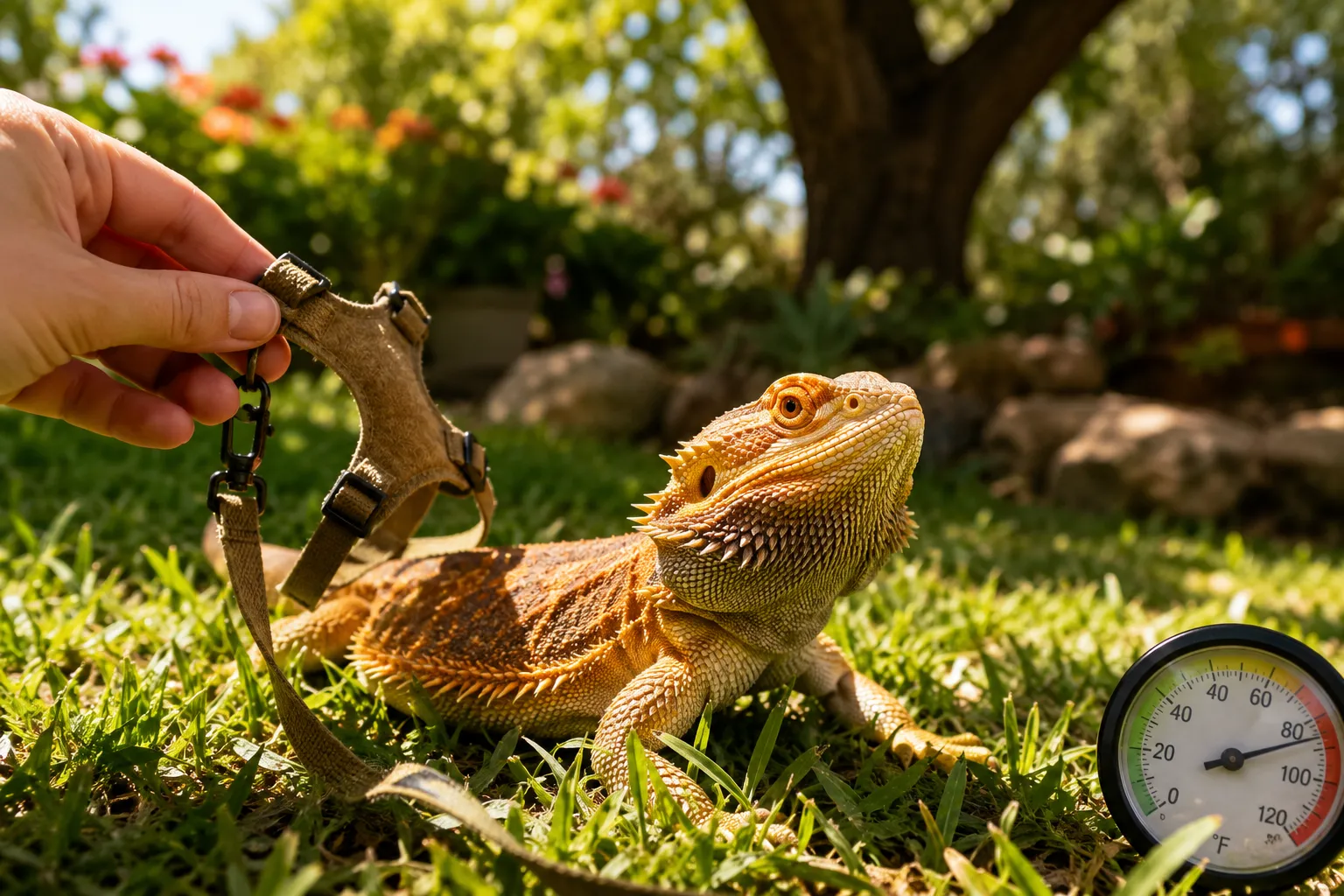
Quick Answer: Yes, you can take a bearded dragon outside, and doing so provides valuable natural UVB exposure and mental stimulation. However, outdoor time requires careful temperature monitoring (ambient temps should be 75-85°F minimum), constant supervision, parasite prevention, and proper restraint using a harness. Sessions should start at 10-15 minutes for gradual acclimation, with outdoor time limited to warm, sunny days when conditions are safe.
Key Takeaways
- Natural UVB is beneficial but requires temperatures above 75°F and constant supervision to prevent predators, escape, or stress
- Adult bearded dragons tolerate outdoor time better than juveniles; babies under 6 months should have minimal or no outdoor exposure
- Always use a reptile harness and leash to prevent escape; bearded dragons can run surprisingly fast when startled
- Limit initial sessions to 10-15 minutes, gradually increasing to 30-60 minutes as your dragon acclimates
- Avoid temperatures below 70°F or above 95°F without access to shade; cold stress and overheating are serious risks
- Outdoor parasites are a real concern; avoid areas with wild reptile droppings and consider regular fecal exams
- Never leave your dragon unattended outside, even in a secure enclosure; birds of prey and cats pose immediate threats
- Winter outdoor time is generally unsafe in most climates; stick to late spring through early fall
- Watch for stress signals like darkened beard, frantic running, or hiding attempts; remove your dragon immediately if these occur
- Yard insects can be eaten but avoid fireflies, lightning bugs, and any insects from pesticide-treated areas

Harness and Leash Size: This harness is suitable for small animal with neck circumference: 4.5"-7" and chest circumference: 6.4"-8.6". In addition, this harness also comes with a 5ft short leash, which is suitable for use when walking outdoors.
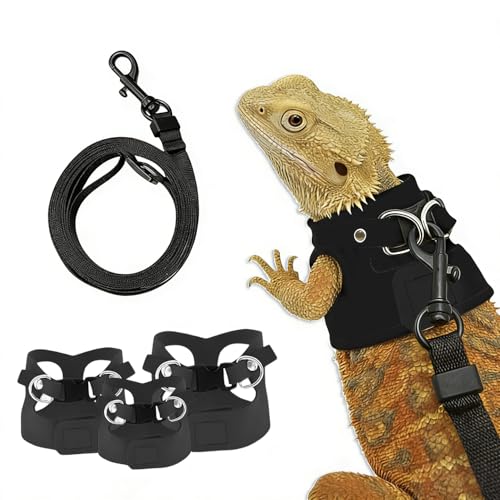
【Microfiber Leather for Comfort】Made from microfiber leather, this harness prevents chafing while ensuring secure, gentle restraint. Ideal for stress-free walks without restricting movement

【Complete Reptile Harness Leash Set】 Everything you need in one package: one full harness and leash set, ready for daily outings, travel, or outdoor bonding time with your scaly companion
Is It Safe to Take My Bearded Dragon Outside?
Taking a bearded dragon outside is safe when done correctly, but it requires active supervision and proper environmental conditions. The primary benefits include natural UVB exposure (which is more effective than artificial lighting) and behavioral enrichment. However, outdoor time introduces risks that don’t exist in controlled indoor environments.
Key safety requirements include:
- Ambient temperature between 75-85°F (basking spots can reach 90-95°F in direct sun)
- Constant visual supervision to prevent predator attacks
- Secure harness and leash to prevent escape
- Access to both sun and shade
- Awareness of potential toxins (pesticides, treated grass, dangerous insects)
Common dangers to watch for:
- Predators: Hawks, cats, dogs, and even crows will attack bearded dragons
- Escape: A startled dragon can sprint faster than most people expect
- Temperature shock: Rapid temperature changes cause stress and potential respiratory infection
- Parasites: Wild insects and contaminated soil can transmit parasites
- Toxic insects: Fireflies are deadly to bearded dragons and should never be consumed
The safest approach is to treat outdoor time as a supervised enrichment activity, not a replacement for proper indoor habitat maintenance. Never assume your dragon is safe just because it’s in your yard.
What Temperature Is Too Cold for Bearded Dragons Outside?
Bearded dragons should not be outside when ambient temperatures drop below 70°F, and 75°F is a safer minimum threshold. These desert reptiles cannot regulate their own body temperature and rely entirely on external heat sources. Cold exposure leads to lethargy, digestive shutdown, respiratory infections, and potentially fatal hypothermia.
Temperature guidelines for outdoor time:
- Ideal range: 75-85°F ambient, with basking spots reaching 90-95°F in direct sunlight
- Minimum safe temperature: 70°F (and only for brief, supervised periods)
- Danger zone: Below 65°F causes immediate stress and health risks
- Maximum temperature: Above 95°F without shade access risks overheating
Signs your dragon is too cold:
- Darkened skin color (attempting to absorb more heat)
- Lethargy or refusal to move
- Seeking to burrow or hide
- Slow, sluggish movements
- Gaping mouth while trying to warm up (unusual in cold conditions)
Signs of overheating:
- Excessive gaping (mouth wide open)
- Attempting to dig or escape
- Pale or washed-out coloration
- Frantic behavior or glass surfing when returned to enclosure
Always bring a portable thermometer outside to monitor conditions. Weather apps show air temperature, but ground temperature in direct sun can be 10-15°F higher. Check the surface where your dragon will sit before placing them down.
How Long Can Bearded Dragons Stay Outside?
Bearded dragons can safely stay outside for 30-60 minutes during ideal conditions, but first-time outdoor sessions should be limited to 10-15 minutes. Duration depends on temperature stability, your dragon’s stress level, and your ability to maintain constant supervision.
Recommended outdoor session lengths:
- First exposure: 10-15 minutes to assess tolerance and stress response
- Acclimated adults: 30-60 minutes in stable, ideal conditions
- Juveniles (6-12 months): 15-30 minutes maximum
- Hot days (above 90°F): 20-30 minutes with mandatory shade access
- Cooler days (70-75°F): 15-20 minutes, monitoring for cold stress
Factors that shorten safe outdoor time:
- Cloud cover reducing UVB and warmth
- Wind chill lowering effective temperature
- Visible stress behaviors (darkened beard, attempts to flee)
- Presence of potential predators (birds circling, neighborhood cats)
- Your dragon’s first few outdoor experiences
When to end the session immediately:
- Temperature drops below 70°F or rises above 95°F
- Your dragon shows stress signals (frantic movement, darkened coloration)
- Predators appear in the area
- Weather changes (clouds blocking sun, wind picking up)
- You need to look away or go inside for any reason
Never extend outdoor time just because your dragon appears calm. Reptiles don’t show distress the same way mammals do, and by the time symptoms are obvious, stress or temperature damage may already be occurring. For more information on recognizing stress behaviors, check out our guide on bearded dragon behavior.
Do Bearded Dragons Need a Leash or Harness Outside?
Yes, bearded dragons absolutely need a properly fitted reptile harness and leash for outdoor time. Even the calmest, most handleable dragon can bolt when startled by a sudden noise, shadow, or unfamiliar stimulus. Bearded dragons can run at speeds up to 9 mph in short bursts, making them nearly impossible to catch once they escape.
Why harnesses are non-negotiable:
- Prevents escape when your dragon is startled
- Allows you to quickly remove your pet from danger
- Provides control if a predator approaches
- Enables safe exploration of larger outdoor areas
- Required if you’re distracted even momentarily
Choosing the right harness:
- Look for adjustable reptile-specific harnesses (not cat or ferret harnesses)
- Figure-8 or vest-style designs distribute pressure evenly
- Soft, breathable material that won’t chafe scales
- Secure but not tight; you should fit one finger between harness and body
- Bright colors make your dragon more visible to you
Proper harness fitting:
- Measure around the widest part of your dragon’s body (just behind front legs)
- Adjust straps so the harness sits snugly but doesn’t restrict breathing
- Check that your dragon can move legs freely and expand ribs to breathe
- Test indoors first; let your dragon wear it for 5-10 minutes before going outside
- Attach a lightweight leash (4-6 feet is ideal for control and freedom)
Common mistakes to avoid:
- Using string, ribbon, or makeshift restraints (these can injure your dragon)
- Leaving harness too loose (dragon can slip out backward)
- Attaching leash to collar-style harness (puts dangerous pressure on neck)
- Assuming your dragon won’t run because it’s calm indoors
Even in a secure outdoor enclosure, keep the harness on. If a predator appears or your dragon panics, you’ll need immediate control to protect your pet.
Can Bearded Dragons Get Parasites from Going Outside?
Yes, bearded dragons can contract parasites from outdoor exposure, particularly from contaminated soil, wild insects, and areas where other reptiles have been. Common parasites include pinworms, coccidia, and various protozoan infections that cause digestive issues, weight loss, and lethargy.
Primary parasite transmission routes:
- Contaminated soil: Areas where wild lizards, snakes, or other reptiles defecate
- Wild insects: Crickets, roaches, and other bugs can carry internal parasites
- Standing water: Puddles and birdbaths may contain protozoan parasites
- Direct contact: With wild reptiles or their droppings
Risk reduction strategies:
- Choose clean, maintained lawn areas away from wild reptile habitats
- Avoid areas with visible animal droppings (any species)
- Don’t let your dragon drink from outdoor water sources
- Prevent consumption of wild insects in high-risk areas
- Wash your hands before and after outdoor sessions
When to schedule fecal exams:
- Before starting regular outdoor time (establish baseline)
- Every 6 months if your dragon goes outside regularly
- Immediately if you notice diarrhea, weight loss, or lethargy
- After any exposure to wild reptiles or their habitats
Symptoms of parasitic infection:
- Loose, watery, or unusually smelly feces
- Unexplained weight loss despite normal appetite
- Lethargy or decreased activity level
- Loss of appetite
- Visible worms in feces (rare but definitive)
The parasite risk is real but manageable. Many bearded dragon owners provide outdoor time for years without issues by following basic hygiene practices and monitoring their pet’s health. Regular veterinary fecal exams (simple and inexpensive) catch infections early before they cause serious problems. For more on maintaining your dragon’s health, see our reptile health resources.
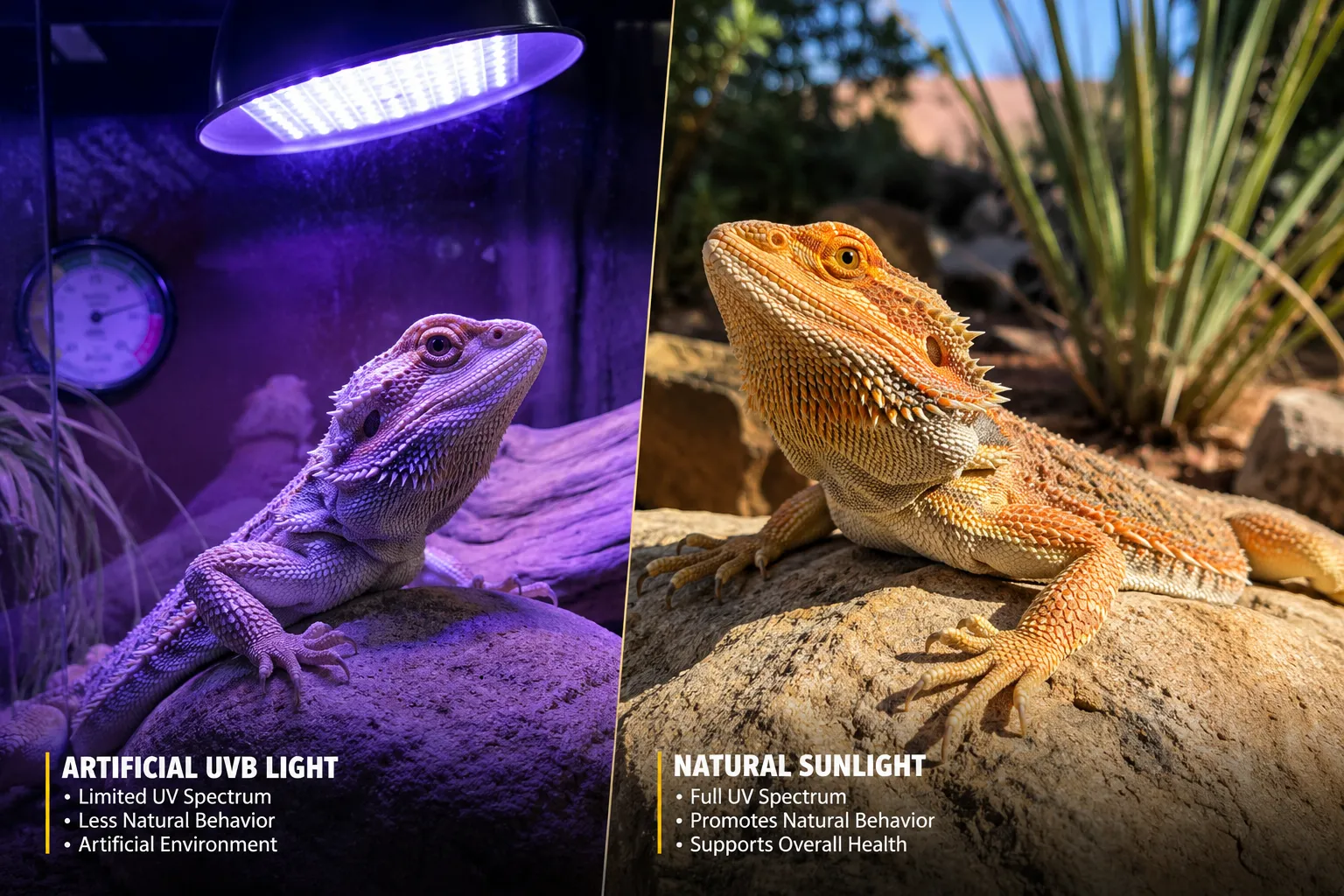
Bearded Dragon Outside vs UVB Lamp: Which Is Better?
Natural sunlight provides superior UVB compared to artificial lamps, but indoor UVB lighting is more reliable, controllable, and safer for daily use. The ideal approach combines both: high-quality UVB bulbs for consistent daily exposure and supervised outdoor time as supplemental enrichment during appropriate weather.
Natural sunlight advantages:
- Full-spectrum UVB (including UVB wavelengths artificial bulbs can’t replicate)
- Vitamin D3 synthesis is more efficient under natural sun
- Behavioral enrichment and mental stimulation
- Natural temperature gradients for thermoregulation
- Free (no electricity costs or bulb replacements)
Natural sunlight disadvantages:
- Weather-dependent and seasonal (unusable in winter for most climates)
- Requires constant supervision
- Introduces parasite and predator risks
- Temperature can be difficult to control
- UVB exposure through window glass is ineffective (glass blocks UVB)
Artificial UVB lamp advantages:
- Consistent, year-round exposure regardless of weather
- Controlled intensity and duration
- Safe, predator-free environment
- No parasite exposure risk
- Can be used during work hours without supervision
Artificial UVB lamp disadvantages:
- Bulbs degrade over time (replace every 6-12 months even if still producing visible light)
- Less effective than natural sun for vitamin D3 synthesis
- Requires proper distance and positioning
- Ongoing cost for bulbs and electricity
- No behavioral enrichment value
Best practice approach:
Use high-quality UVB bulbs (10.0 or 12% UVB tube-style bulbs) as your dragon’s primary UVB source, positioned 8-12 inches from basking spot. Supplement with outdoor time 1-3 times per week during warm months for enrichment and enhanced vitamin D3 production. This combination provides reliability while maximizing health benefits.
Never rely solely on outdoor time for UVB needs. Weather changes, seasonal variations, and schedule conflicts make outdoor-only UVB impractical and potentially dangerous if your dragon goes weeks without adequate exposure.
What Are the Risks of Taking a Bearded Dragon Outside?
Taking a bearded dragon outside introduces several serious risks that don’t exist in controlled indoor environments. While these risks are manageable with proper precautions, understanding them is essential for keeping your pet safe during outdoor sessions.
Primary risks ranked by severity:
1. Predator attacks (highest risk)
- Birds of prey (hawks, owls, crows) can strike in seconds
- Cats and dogs may attack even if they seem friendly
- Raccoons, opossums, and foxes in suburban areas
- Even small birds may harass or stress your dragon
2. Escape and loss
- Startled dragons can sprint at 9 mph
- Can hide in small spaces (under decks, in bushes, storm drains)
- Difficult to locate once out of sight
- May not survive overnight if not recovered
3. Temperature-related illness
- Hypothermia from cold exposure (below 70°F)
- Overheating and heat stroke (above 95°F without shade)
- Respiratory infections from rapid temperature changes
- Metabolic shutdown from prolonged cold stress
4. Toxic exposure
- Fireflies and lightning bugs are deadly
- Pesticide-treated grass and plants
- Fertilizers and weed killers
- Toxic plants (azaleas, oleander, rhododendron)
5. Parasite transmission
- Internal parasites from contaminated soil
- Wild insects carrying parasites
- Protozoan infections from standing water
6. Stress and behavioral issues
- Overwhelming sensory stimulation
- Fear response to unfamiliar environments
- Potential for long-term stress if forced outside when uncomfortable
Risk mitigation checklist:
- ✓ Use a properly fitted harness and leash at all times
- ✓ Maintain constant visual contact (never look away)
- ✓ Check temperature before and during outdoor time
- ✓ Provide both sun and shade access
- ✓ Choose clean areas away from wild animal traffic
- ✓ Watch for predators (scan the sky and surroundings regularly)
- ✓ Start with short sessions (10-15 minutes) to assess tolerance
- ✓ Have an indoor backup plan if weather changes
Understanding these risks doesn’t mean outdoor time is too dangerous to attempt. It means you need to be prepared, attentive, and ready to intervene. Thousands of bearded dragon owners successfully provide outdoor enrichment by respecting these hazards and planning accordingly.
Can Baby Bearded Dragons Go Outside or Just Adults?
Baby bearded dragons (under 6 months old) should have minimal to no outdoor exposure, while juveniles (6-12 months) can have brief, carefully supervised sessions. Adult bearded dragons (over 12 months) tolerate outdoor time best and benefit most from natural UVB exposure.
Age-based outdoor guidelines:
Babies (0-6 months):
- Outdoor time is generally not recommended
- Extremely vulnerable to temperature fluctuations
- Higher predator risk due to small size
- Stress from outdoor stimulation can impact growth
- If outdoor time is attempted, limit to 5-10 minutes maximum
Juveniles (6-12 months):
- Can begin outdoor time in ideal conditions
- Limit sessions to 15-20 minutes
- Require even closer supervision than adults
- More prone to stress and escape attempts
- Should only go outside on warm, calm days (75-85°F)
Adults (12+ months):
- Best candidates for regular outdoor time
- Can handle 30-60 minute sessions
- More stable temperature regulation
- Calmer temperament reduces escape risk
- Still require all safety precautions
Why babies are more vulnerable:
- Smaller body mass means faster heat loss and gain
- Less developed immune systems increase parasite risk
- More easily stressed by novel environments
- Faster movements make them harder to control
- Predators view them as easier targets
Signs your young dragon isn’t ready:
- Darkened beard or stress coloration during handling
- Frantic movements or escape attempts indoors
- Skittish behavior around new stimuli
- Recent health issues or poor appetite
- Weight below healthy range for age
If you want to provide UVB benefits for young bearded dragons, focus on high-quality indoor UVB bulbs positioned correctly. The risks of outdoor exposure for babies and juveniles typically outweigh the benefits. Wait until your dragon is at least 8-10 months old and well-acclimated to handling before introducing outdoor time. For more on caring for bearded dragons at different life stages, visit our bearded dragon care guide.
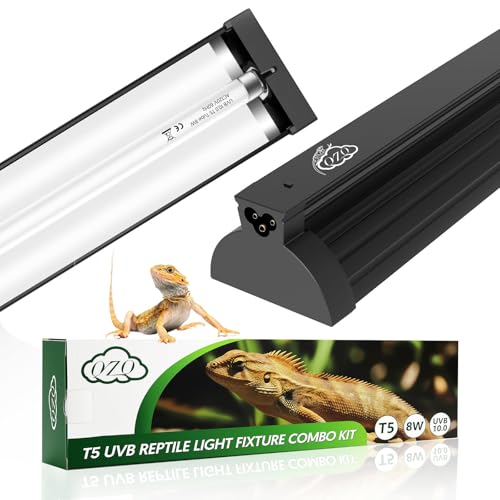
T5 UVB Reptile Light Fixture Combo Kit: The QZQ T5 UVB reptile light features a 5.9ft detachable power cord, a convenient on/off switch, and multiple mounting accessories for easy installation. Whether you're setting up a reptile tank or terrarium, this reptile light fixture meets your reptile lighting needs, providing your pets with the perfect 10.0 UVB lighting environment for healthy growth

T5 Reptile Light Fixture with UVB 10.0 Bulb Kit - The REPTIDLDB T5 reptile light fixture comes with a UVB 10.0 bulb kit, offering 10% UVB and 30% UVA output. This lighting system provides a natural and balanced lighting environment, ensuring your reptiles receive the proper UVB radiation for optimal health. The fixture is designed with minimal heat emission, making it perfect for your reptile's habitat without overheating the enclosure. The UVB 10.0 bulb is replaceable, giving you flexibility and convenience in maintaining your reptile’s environment.

Low Degradation & Longer-Lasting UVB Radiation - LUCKY HERP 23W UVB 10.0 reptile light bulb is continuously updated with technology to ensure low degradation of UVB radiation, providing long-lasting and stable UVB output. This continuous and stable UVB radiation is crucial for the health of reptile pets. Our UVB light bulb can provide your pet with longer-lasting UVB exposure, with a UVB lifespan of up to 1 year, reducing the need for frequent bulb replacements.
My Bearded Dragon Got Stressed Outside: What Did I Do Wrong?
If your bearded dragon showed stress during outdoor time, the most common causes are temperature discomfort, sensory overload, insufficient acclimation time, or the presence of perceived threats. Stress responses are protective mechanisms, and recognizing them helps you adjust your approach for future sessions.
Common stress triggers outdoors:
- Temperature issues: Too cold (below 75°F) or too hot (above 90°F without shade)
- Sudden environmental change: Moving from indoor enclosure directly to bright outdoor sun
- Overwhelming stimuli: Wind, loud noises, unfamiliar smells, moving shadows
- Perceived predators: Birds flying overhead, dogs barking, cats nearby
- Handling stress: Being picked up and moved when not ready
- Session too long: Exceeding your dragon’s tolerance level
Stress signals to watch for:
- Darkened beard (most obvious sign)
- Frantic running or escape attempts
- Flattened body posture (trying to appear larger)
- Hissing or aggressive displays (rare but definitive)
- Attempting to burrow or hide
- Rapid color changes (darkening overall body color)
- Gaping while trying to escape (different from temperature-regulating gaping)
What to do when stress occurs:
- Remove your dragon immediately – Don’t wait to see if they calm down
- Return to familiar indoor environment – Place in their enclosure with normal temperatures
- Minimize handling – Let them decompress without additional stress
- Monitor for 24-48 hours – Watch appetite, behavior, and feces for signs of ongoing stress
- Adjust your approach – Identify what triggered the stress before trying again
How to prevent stress in future sessions:
- Gradual acclimation: Start with 5-10 minutes and slowly increase duration over multiple sessions
- Choose calm days: Avoid windy, cloudy, or noisy conditions for first exposures
- Warm up first: Let your dragon bask indoors before going outside
- Provide hiding options: Bring a small hide or towel they can retreat under
- Stay close: Your presence can be reassuring; don’t walk away
- Watch the sky: Remove your dragon if birds appear overhead
When to skip outdoor time entirely:
- Your dragon is shedding (skin is more sensitive)
- Recent health issues or veterinary visits
- Temperatures outside ideal range (75-85°F)
- Windy or stormy weather approaching
- Your dragon showed stress during last session
Some bearded dragons simply don’t enjoy outdoor time, and that’s okay. Not every dragon has the temperament for outdoor enrichment. If your dragon consistently shows stress despite gradual acclimation and ideal conditions, respect their preference and focus on indoor enrichment instead. Forcing outdoor time on a stressed dragon causes more harm than benefit.
Bearded Dragon Outdoor Enclosure Setup Ideas
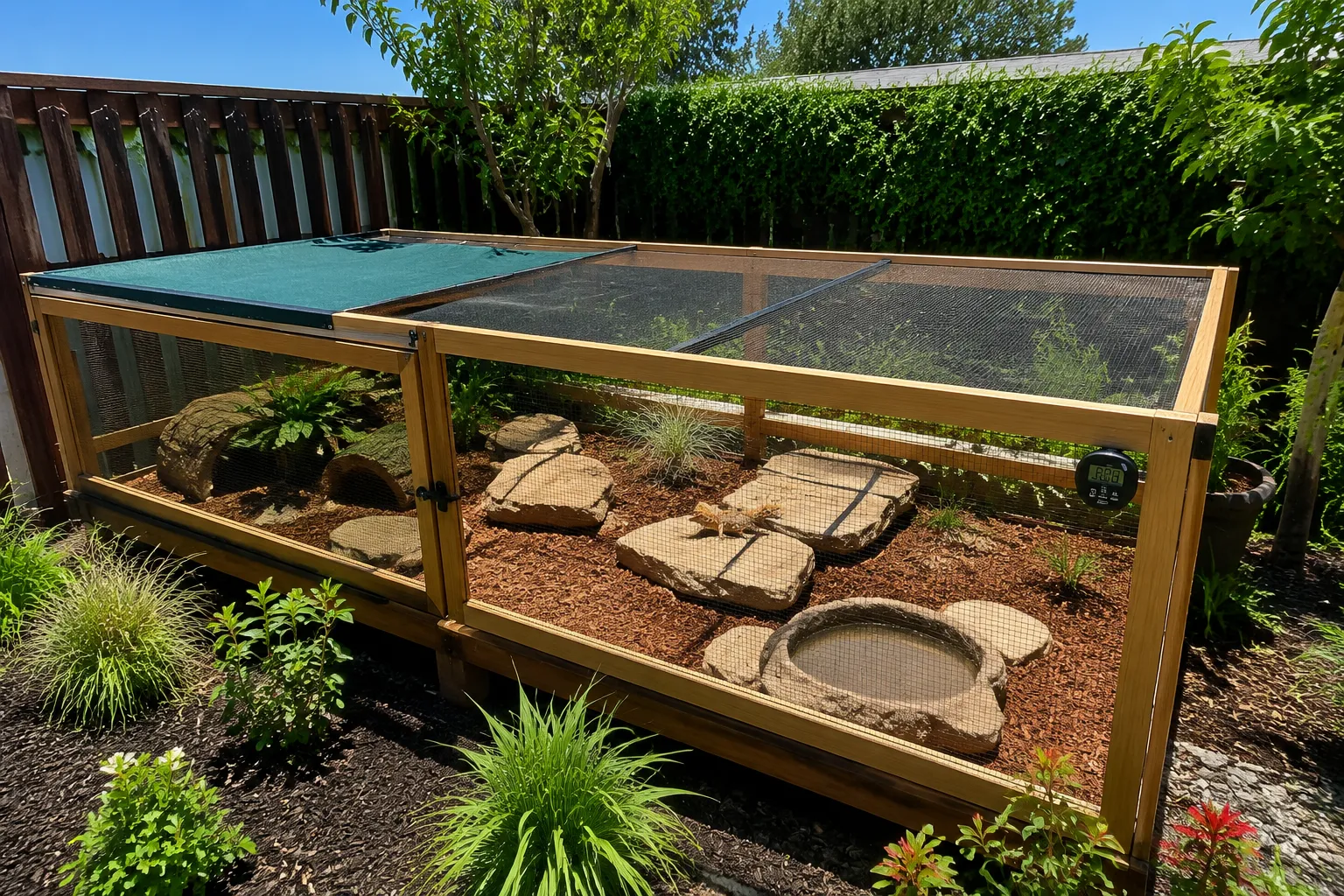
A dedicated outdoor enclosure allows longer, safer outdoor sessions while reducing supervision demands. However, even secure enclosures require nearby monitoring because predators can breach or stress your dragon through the barriers.
Essential outdoor enclosure features:
1. Secure top cover
- Hardware cloth or welded wire mesh (not chicken wire)
- Minimum 1/4-inch mesh to prevent snake entry
- Secured on all sides to prevent predator access
- Partial shade cloth section (blocks 30-50% sun)
2. Temperature management
- Both full sun and full shade areas
- Flat basking rocks or platforms
- Thermometer mounted inside enclosure
- Easy access to move dragon if temperature becomes unsafe
3. Substrate and flooring
- Natural grass (untreated, no pesticides)
- Flat stones or pavers for basking
- Avoid sand (impaction risk if ingested)
- Ensure drainage to prevent standing water
4. Enrichment and furniture
- Logs or branches for climbing
- Flat rocks at different heights
- Safe plants (avoid toxic species)
- Shallow water dish (changed frequently)
5. Security features
- Buried barrier 6-12 inches deep (prevents digging predators)
- Locking door or access panel
- No gaps larger than 1/4 inch anywhere
- Elevated off ground if possible (deters ground predators)
Enclosure size recommendations:
- Minimum: 4 feet × 4 feet for adult dragon
- Ideal: 6 feet × 6 feet or larger
- Height: 18-24 inches (prevents jumping/climbing out)
Setup mistakes to avoid:
- Glass or solid walls (trap heat, prevent airflow)
- Placing enclosure under trees (bird droppings, predator access)
- No shade option (overheating risk)
- Leaving dragon unattended for extended periods
- Using enclosure during inappropriate temperatures
Portable vs. permanent enclosures:
Portable (pop-up style):
- Easy to move for optimal sun exposure
- Can be stored when not in use
- Less expensive and easier to set up
- Must be secured to prevent tipping
Permanent (built structure):
- More secure against predators
- Better temperature control options
- Can include planted areas and complex enrichment
- Requires more investment and yard space
Even with a secure outdoor enclosure, check on your dragon every 10-15 minutes. Temperature can change quickly, predators can cause stress even without physical access, and equipment can fail. An outdoor enclosure is a tool for safer outdoor time, not a replacement for supervision. For more on creating optimal environments, see our guide on reptile habitat setup.
Can Bearded Dragons Be Outside in Winter?
Bearded dragons should not be outside in winter in most climates because temperatures typically fall well below the safe minimum of 70-75°F. Even in mild winter climates, temperature fluctuations, reduced UVB intensity, and shorter daylight hours make winter outdoor time risky and generally not worth the minimal benefits.
Why winter outdoor time is dangerous:
- Ambient temperatures rarely reach safe minimums (75°F+)
- Ground temperature is often 10-15°F colder than air temperature
- Sun angle reduces UVB intensity (less effective vitamin D3 synthesis)
- Shorter days limit available outdoor time windows
- Rapid temperature drops as sun sets
- Wind chill makes effective temperature even colder
Climate-specific considerations:
Cold climates (winter lows below 40°F):
- No outdoor time from late fall through early spring
- Even sunny winter days rarely reach safe temperatures
- Risk of hypothermia is extremely high
Moderate climates (winter lows 40-60°F):
- Outdoor time only on exceptionally warm, sunny days (75°F+)
- Limit to midday hours (11 AM – 2 PM)
- Sessions should be brief (15-20 minutes maximum)
Warm climates (winter lows above 60°F):
- Outdoor time possible on warm days
- Still monitor temperature closely
- Avoid early morning and evening sessions
Safe seasonal schedule:
- Spring (March-May): Begin outdoor time as temperatures stabilize above 75°F
- Summer (June-August): Peak outdoor season; watch for overheating
- Fall (September-November): Continue until daytime highs drop below 75°F consistently
- Winter (December-February): Indoor UVB only for most climates
Indoor alternatives during winter:
- High-quality UVB tube bulbs (10.0 or 12% UVB)
- Mercury vapor bulbs (provide both heat and UVB)
- Increased basking time indoors
- Behavioral enrichment through handling and exploration of safe indoor spaces
- Proper supplementation with calcium and vitamin D3
Exception: Controlled outdoor enclosures with heating
Some dedicated keepers build insulated outdoor enclosures with supplemental heating for year-round use. This requires:
- Thermostatically controlled heat sources
- Insulated walls and roof
- Temperature monitoring systems
- Backup power for heating elements
- Significant investment and maintenance
For most bearded dragon owners, winter is the season to focus on optimizing indoor habitat conditions rather than attempting outdoor time. The risks of cold exposure far outweigh any potential benefits during winter months. Plan outdoor enrichment for spring through fall when conditions naturally support your dragon’s needs.
How to Safely Introduce My Bearded Dragon to Outdoor Time
Introducing a bearded dragon to outdoor time requires gradual acclimation, ideal weather conditions, and close monitoring of your pet’s response. Rushing the process or choosing poor conditions for first exposure can create lasting stress associations with outdoor environments.
Step-by-step introduction process:
Week 1-2: Indoor preparation
- Ensure your dragon is comfortable with regular handling
- Practice putting on and wearing the harness indoors
- Let your dragon wear the harness for 10-15 minutes daily
- Reward calm behavior with favorite treats
- Verify your dragon is healthy (good appetite, normal feces, active)
Week 3: First outdoor exposure
- Choose a calm, sunny day with temperatures 75-85°F
- Pick a quiet time (avoid lawn mowers, traffic, neighborhood activity)
- Bring your dragon outside in your arms (don’t walk them out)
- Sit on the ground with your dragon in your lap for 5 minutes
- Let them observe surroundings without forcing exploration
- Return inside before any stress signs appear
Week 4-5: Gradual exploration
- Increase session length to 10-15 minutes
- Allow your dragon to walk on grass while you hold the leash
- Stay within 2-3 feet at all times
- Provide access to both sun and shade
- Watch for stress signals (darkened beard, frantic movement)
- End sessions on a positive note (before stress occurs)
Week 6+: Extended sessions
- Increase duration to 20-30 minutes if your dragon remains calm
- Introduce new areas of your yard gradually
- Allow more independent exploration (while leashed)
- Monitor temperature throughout session
- Build up to 45-60 minute sessions over several weeks
Conditions for successful first exposure:
- Temperature: 78-85°F (ideal range, not too hot or cold)
- Weather: Sunny, calm, no wind
- Time of day: Late morning to early afternoon (10 AM – 2 PM)
- Location: Quiet, familiar yard area away from street noise
- Your schedule: When you have 30+ minutes without interruptions
Signs your dragon is acclimating well:
- Calm, relaxed body posture
- Normal or slightly lighter coloration
- Willingness to explore (slow, deliberate movements)
- Basking behavior (flattening body in sun)
- Normal breathing (no gaping unless temperature-regulating)
Red flags to watch for:
- Darkened beard or body color
- Attempts to run or escape
- Hiding behavior or seeking to burrow
- Hissing or defensive postures
- Refusal to move (frozen in fear)
What to do if introduction goes poorly:
- Don’t force continued exposure
- Return inside immediately
- Wait 1-2 weeks before trying again
- Reassess conditions (was it too cold, too windy, too stimulating?)
- Consider that some dragons simply don’t enjoy outdoor time
Pro tips for smooth introduction:
- Bring a familiar hide or towel your dragon can retreat under
- Start outdoor sessions after your dragon has eaten (not hungry or hunting)
- Avoid outdoor time during shedding (skin is more sensitive)
- Have a second person present for first few sessions (extra eyes for safety)
- Take photos/videos to document your dragon’s body language for future reference
Remember that every bearded dragon has a unique personality. Some take to outdoor time immediately, while others need weeks of gradual acclimation. Respect your dragon’s individual comfort level and never rush the process. The goal is enrichment, not stress. For more on understanding your dragon’s communication, check out our guide on reptile body language.
Do Bearded Dragons Try to Run Away When Outside?
Yes, bearded dragons may attempt to run away when outside, especially if startled by sudden movements, shadows, or unfamiliar stimuli. Even well-socialized dragons that are calm indoors can bolt when exposed to the overwhelming sensory input of outdoor environments. This is why a properly fitted harness and leash are absolutely essential for outdoor time.
Why bearded dragons run:
- Predator response: Instinctive reaction to birds, shadows, or sudden movements
- Sensory overload: Too many new sights, sounds, and smells at once
- Temperature discomfort: Seeking warmer or cooler areas
- Exploration drive: Natural curiosity about new environment
- Fear response: Unfamiliar surroundings trigger escape instinct
How fast can bearded dragons run?
Bearded dragons can sprint at speeds up to 9 mph in short bursts. While this doesn’t sound fast compared to mammals, it’s more than quick enough to disappear into bushes, under decks, or into storm drains before you can react. Once out of sight, they’re extremely difficult to locate and may not survive overnight exposure.
Factors that increase escape attempts:
- First few outdoor exposures (unfamiliar environment)
- Sudden loud noises (lawn mowers, cars, dogs barking)
- Birds flying overhead (triggers predator response)
- Wind moving plants or creating shadows
- Other pets or people approaching
- Temperature discomfort (too hot or too cold)
How to prevent escape:
- Always use a harness and leash (non-negotiable)
- Maintain constant visual contact (never look away)
- Keep leash short initially (2-3 feet until acclimated)
- Choose calm, quiet times for outdoor sessions
- Acclimate gradually (start with brief, low-stimulation sessions)
- Stay close (within arm’s reach for first several sessions)
- Watch for triggers (birds, shadows, noises) and be ready to secure your dragon
What to do if your dragon bolts:
- With harness: Gently but firmly hold the leash; don’t yank (can injure your dragon)
- Without harness: Move quickly but calmly to block escape routes; avoid lunging (makes them run faster)
- If they hide: Don’t reach in blindly; use food to lure them out
- If they escape: Search immediately; check under bushes, decks, and warm spots; bearded dragons often stop running once they find cover
Recovery tips for escaped dragons:
- Search in expanding circles from last seen location
- Check warm areas (sunny spots, near building foundations)
- Look under low structures (decks, sheds, cars)
- Place their enclosure or a hide box outside with familiar scents
- Search at dawn and dusk when they’re more likely to move
- Alert neighbors and post on local lost pet groups immediately
Dragons that are less likely to run:
- Adults over 18 months (calmer temperament)
- Dragons with extensive handling experience
- Pets that have been gradually acclimated to outdoor time
- Dragons taken outside during optimal conditions (calm, warm, quiet)
Even the calmest bearded dragon can have an unexpected fear response. Never become complacent about escape risk, even after dozens of successful outdoor sessions. One moment of inattention or one unexpected trigger can result in a lost pet. The harness and leash are your insurance policy against tragedy.
What Bugs Can Bearded Dragons Eat Outside in the Yard?
Bearded dragons can safely eat many common yard insects, but several species are toxic or dangerous. The safest approach is to prevent consumption of wild insects entirely during outdoor time, but if your dragon catches bugs, knowing which are safe versus deadly is critical.
Safe yard insects (in moderation):
- Grasshoppers: Excellent protein source, safe if from pesticide-free areas
- Crickets: Safe but may carry parasites; wild crickets are less nutritious than farmed
- Roaches: Safe species include Dubia roaches (if they’ve escaped your colony)
- Black soldier fly larvae: Safe and nutritious
- Earthworms: Safe but should be from clean soil (not near roads or treated areas)
Dangerous or toxic insects (NEVER allow):
- Fireflies/Lightning bugs: Contain lucibufagin toxin; deadly even in small amounts
- Boxelder bugs: Toxic and can cause serious illness
- Monarch butterflies: Contain cardiac glycosides from milkweed
- Ladybugs: Secrete toxic alkaloids as defense
- Ants: Many species bite/sting; fire ants are especially dangerous
- Bees and wasps: Stinging risk
- Spiders: Venom risk, especially from widow or recluse species
Insects to avoid due to parasite risk:
- Wild-caught flies (often carry parasites)
- Beetles (hard exoskeletons can cause impaction)
- Moths (may have been exposed to pesticides)
- Any insect found near animal feces
Pesticide concerns:
Even safe insect species become dangerous if they’ve been exposed to:
- Lawn treatments (weed killers, fertilizers)
- Insecticides (even “pet-safe” products)
- Treated plants or gardens
- Runoff from treated neighboring properties
Best practices for outdoor insect consumption:
- Prevent consumption when possible: Keep your dragon on clean pavers or areas without many insects
- Know your yard: Only allow insect consumption if you’re certain no pesticides have been used
- Identify before allowing: If you can’t positively identify an insect as safe, prevent consumption
- Limit quantity: Even safe insects should be occasional treats, not primary food source
- Monitor afterward: Watch for signs of illness (lethargy, vomiting, diarrhea) for 24-48 hours
Signs of toxic insect consumption:
- Excessive drooling or foaming at mouth
- Vomiting or regurgitation
- Lethargy or weakness
- Tremors or seizures
- Loss of coordination
- Refusal to eat
Emergency response for toxic insect ingestion:
- Remove your dragon from outdoor area immediately
- Contact reptile veterinarian or emergency vet right away
- Identify the insect if possible (take photo)
- Do not attempt home treatment
- Transport to vet immediately if symptoms appear
Safer alternative:
Rather than relying on yard insects, bring approved feeder insects outside in a small container. This allows your dragon to hunt and eat during outdoor time without the risks associated with wild-caught bugs. For more on safe feeding practices, visit our bearded dragon feeding guide.
The risk-benefit analysis of allowing wild insect consumption usually favors prevention. The potential for toxic exposure or parasite transmission outweighs the nutritional benefits of occasional grasshoppers or crickets. When in doubt, keep outdoor time focused on UVB exposure and enrichment rather than feeding opportunities.
Frequently Asked Questions
Can I take my bearded dragon outside without a harness if I watch closely?
No, never take a bearded dragon outside without a harness, even with close supervision. Bearded dragons can sprint at 9 mph when startled, making them nearly impossible to catch once they bolt. A single unexpected noise, shadow, or bird overhead can trigger an instant escape response. The harness is essential safety equipment, not optional.
How do I know if my bearded dragon is enjoying outdoor time?
A bearded dragon enjoying outdoor time will display calm, relaxed body language: normal or slightly lighter coloration, slow deliberate movements, basking behavior (flattening body in sun), and willingness to explore. Signs of stress include darkened beard, frantic running, attempts to hide, or frozen immobility. If you see stress signals, end the session immediately.
Can I take my bearded dragon to the park or beach?
Taking a bearded dragon to public spaces like parks or beaches is generally not recommended due to increased risks: more predators, unpredictable people and pets, difficulty controlling temperature, potential pesticide exposure, and higher parasite risk. If you do visit public spaces, choose quiet times, maintain extremely close supervision, and be prepared to leave immediately if conditions become unsafe.
What should I do if my bearded dragon gets too cold outside?
If your bearded dragon shows signs of being too cold (lethargy, darkened color, slow movements), bring them inside immediately and place them in their enclosure with proper basking temperatures (95-105°F basking spot). Allow them to warm gradually; don’t use hot water or heating pads directly on their body. Monitor for respiratory symptoms (wheezing, mucus) over the next 24-48 hours, as cold stress can lead to respiratory infections.
Is morning or afternoon better for outdoor time?
Late morning to early afternoon (10 AM – 2 PM) is ideal for outdoor time because temperatures are stable, UVB intensity is highest, and you have time to monitor conditions before evening temperature drops. Avoid early morning (too cold) and late afternoon/evening (temperature drops quickly, increased predator activity).
Can I leave my bearded dragon in an outdoor enclosure while I’m at work?
No, never leave a bearded dragon in an outdoor enclosure unsupervised for extended periods. Temperature can change rapidly, predators can cause stress or breach enclosures, equipment can fail, and your dragon may need immediate intervention. Outdoor time should always include nearby supervision with checks every 10-15 minutes at minimum.
Do bearded dragons need sunscreen for outdoor time?
No, bearded dragons do not need sunscreen. Their scales provide natural protection, and they require direct UVB exposure for vitamin D3 synthesis. Sunscreen would block beneficial UVB rays and could be toxic if ingested during grooming. Instead, provide access to shade so your dragon can self-regulate sun exposure.
How often should I take my bearded dragon outside?
During appropriate weather (temperatures 75-85°F), you can take your bearded dragon outside 2-4 times per week for 30-60 minute sessions. This frequency provides enrichment benefits without overexposure to outdoor risks. Some owners do daily outdoor time during peak season, while others do weekly sessions. Adjust based on your dragon’s tolerance and your schedule.
Can I take my bearded dragon outside in the rain?
No, avoid taking bearded dragons outside in rain. Rain lowers temperature rapidly, creates slippery conditions that increase injury risk, and can cause respiratory issues if your dragon gets chilled. Additionally, wet conditions make it harder to maintain proper grip on your dragon and increase stress levels. Wait for dry, sunny conditions.
What temperature should the ground be for outdoor time?
Ground temperature should be between 85-95°F in basking areas and 75-80°F in shaded areas. Always test ground temperature with your hand before placing your dragon down; surfaces in direct sun can be 10-15°F hotter than air temperature and may burn your dragon’s feet. Provide flat rocks or pavers that warm in sun but don’t become dangerously hot.
Will outdoor time make my bearded dragon’s colors brighter?
Yes, regular outdoor time often enhances color vibrancy due to improved vitamin D3 synthesis and overall health benefits from natural UVB exposure. However, color improvement takes weeks to months of consistent outdoor time and should never be the primary motivation. Focus on health and enrichment benefits rather than aesthetic changes.
Can I take my bearded dragon outside if it’s shedding?
You can take a shedding bearded dragon outside, but sessions should be shorter (15-20 minutes) and conditions should be ideal. Shedding skin is more sensitive, and stress can interfere with the shedding process. If your dragon seems uncomfortable or stressed during shedding, skip outdoor time until the shed is complete. Natural humidity from outdoor air may actually help with shedding in some cases.
Conclusion
Taking a bearded dragon outside offers valuable benefits including natural UVB exposure, behavioral enrichment, and enhanced vitamin D3 synthesis, but success requires careful planning and constant supervision. The key to safe outdoor time is understanding and managing the risks: temperature extremes, predators, parasites, toxic insects, and escape attempts.
Essential takeaways for safe outdoor sessions:
- Always use a properly fitted reptile harness and leash
- Only venture outside when temperatures are 75-85°F
- Start with 10-15 minute sessions and gradually increase duration
- Maintain constant visual supervision (never leave your dragon unattended)
- Provide both sun and shade access
- Watch for stress signals and end sessions immediately if they appear
- Adult dragons tolerate outdoor time better than juveniles or babies
- Supplement indoor UVB lighting with outdoor time rather than replacing it
Your next steps:
- Assess your dragon’s readiness: Ensure your pet is healthy, comfortable with handling, and at least 8-10 months old
- Invest in proper equipment: Purchase a quality reptile harness, leash, and portable thermometer
- Practice indoors: Acclimate your dragon to wearing the harness before going outside
- Choose ideal conditions: Wait for a calm, sunny day with temperatures in the 75-85°F range
- Start small: Begin with 5-10 minute sessions in a quiet area of your yard
- Monitor and adjust: Watch your dragon’s response and gradually increase duration if they remain calm
Remember that outdoor time is enrichment, not a requirement. Some bearded dragons never enjoy outdoor exposure, and that’s perfectly fine. Focus on providing excellent indoor habitat conditions with proper UVB lighting, and treat outdoor time as a bonus activity when conditions and temperament align.
For more guidance on keeping your bearded dragon healthy and happy, explore our resources on bearded dragon care, reptile health, and understanding bearded dragon behavior. With proper preparation and respect for your dragon’s individual needs, outdoor time can become a rewarding part of your pet care routine.

Precision Health Guardian: Your reptile pets are very sensitive to temperature and humidity, and small changes can affect their comfort and even their health. This humidity thermometer utilizes a built-in high-precision measurement chip that monitors the environment with 0.9°F accuracy, ensuring you are always aware of the actual conditions in your animal's tank. It's not just a matter of caring, it's a consideration for your pet's long-term health.

【Not Only A Thermo-Hygrometer But Also A Terrarium Ventilation Fan】Allows precise monitoring of both temperature and humidity in your terrarium. Terrarium ventilation fan will allow for a constant airflow of fresh air while maintaining the desired ambient tempts and optimum humidity levels for the species that you are keeping

Reptile Necessary: Meet the need of Humidity and Temperature measuring for monitoring reptile's living conditions and health. Easily check your pet's living environment. When there are abnormalities, you can timely discovery through reptile thermometer.