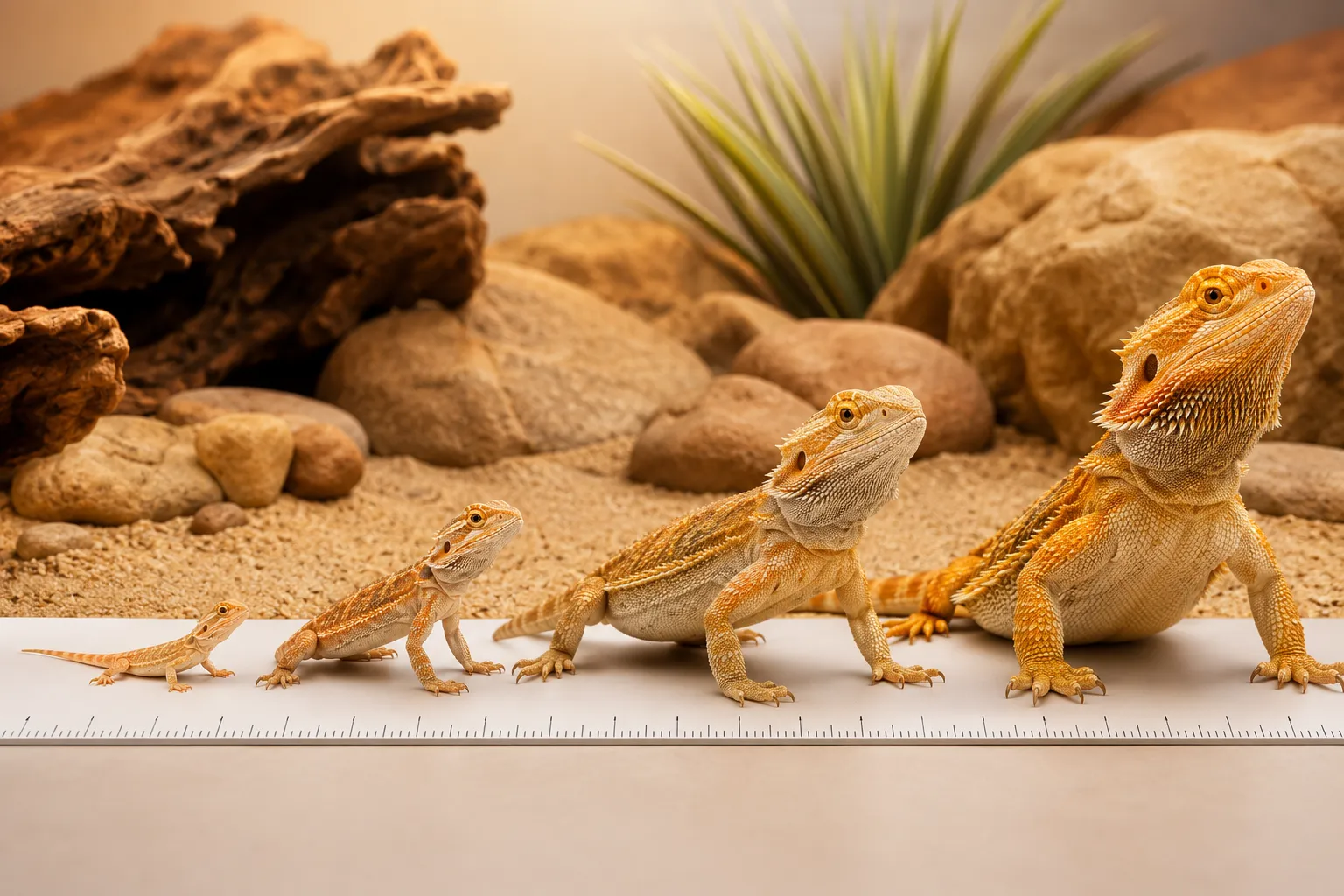
A bearded dragon typically grows from 3-4 inches at hatching to 16-24 inches in length by 12-18 months of age, with most reaching full adult size between 18-24 months. Growth rates vary significantly based on genetics, diet quality, UVB exposure, and overall husbandry, with males generally growing larger than females and reaching 18-24 inches compared to females’ 16-20 inches.
Key Takeaways
- Hatchlings (0-2 months) measure 3-4 inches and grow approximately 1-2 inches per month with proper care
- Juveniles (2-7 months) experience rapid growth, reaching 8-11 inches by month 4 and 11-16 inches by month 7
- Sub-adults (7-12 months) grow more slowly, adding 1-3 inches to reach 16-18 inches by their first birthday
- Adults (12+ months) continue growing until 18-24 months, with final lengths of 16-24 inches depending on sex and genetics
- Males typically grow 2-4 inches longer than females and have broader heads and thicker tail bases
- Proper UVB lighting, calcium supplementation, and protein-rich diets are essential for healthy growth rates
- Dragons smaller than average may still be healthy if they’re active, eating well, and gaining weight consistently
- Growth stunting often results from inadequate UVB, poor nutrition, or temperatures outside the 95-110°F basking range
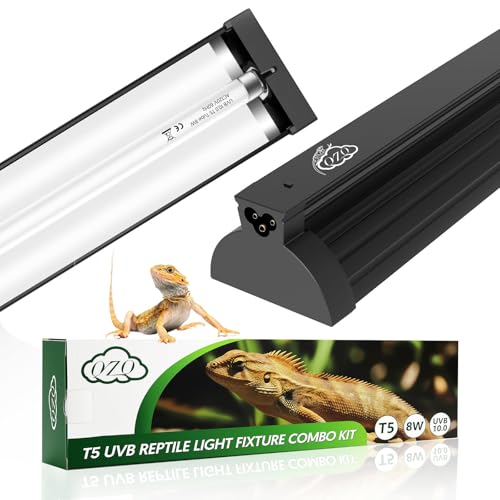
T5 UVB Reptile Light Fixture Combo Kit: The QZQ T5 UVB reptile light features a 5.9ft detachable power cord, a convenient on/off switch, and multiple mounting accessories for easy installation. Whether you're setting up a reptile tank or terrarium, this reptile light fixture meets your reptile lighting needs, providing your pets with the perfect 10.0 UVB lighting environment for healthy growth
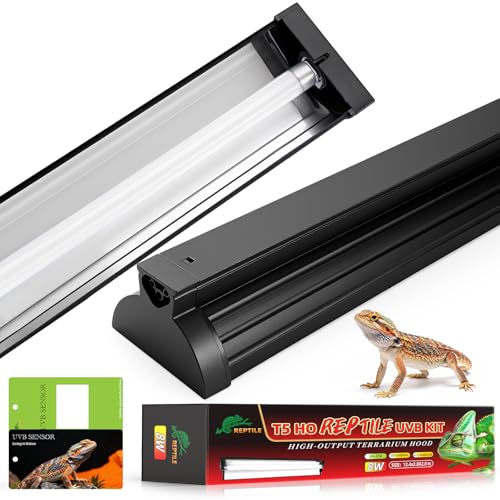
High-Output T5 UVB Reptile Light Fixture Kit - The Haceryc UVB 10.0 Light for Reptile Kit delivers 10% UVB and 30% UVA output. This lighting system provides a naturally balanced illumination environment, ensuring your reptile receives sufficient UVB radiation to support optimal wellbeing. A premium UVB test card is included as a bonus—simply place the test card 3.5 inches (approximately 9 cm) away from the heating lamp, wait 10 seconds, and quickly check for ultraviolet radiation

🌞🌞Higher UVB Output Value. T5 10.0 8W UVB reptile light fixture is 12 inch. Higher UVB output promote reptiles vitamin D3 synthesis and help them grow better. And the reptile UVB light also can help promote the absorption of their calcium and phosphorus, improve their reproductive behavior and boost their immunity.
What Is the Average Size of a Bearded Dragon at 3 Months Old?
A healthy 3-month-old bearded dragon typically measures 8-11 inches in total length (from snout to tail tip) and weighs between 22-110 grams. At this age, babies are transitioning from the hatchling stage into the juvenile phase and should be experiencing rapid, consistent growth.
During the first three months, bearded dragons grow faster than at any other life stage. Here’s what to expect:
- Month 1: 3-4 inches, 4-6 grams
- Month 2: 5-9 inches, 8-40 grams
- Month 3: 8-11 inches, 22-110 grams
The wide weight range at 3 months reflects natural variation between individuals, with factors like clutch size, genetics, and feeding frequency playing significant roles. A dragon at the lower end of this range isn’t necessarily unhealthy if it’s active, alert, and eating well.
Choose this benchmark if: Your dragon came from a reputable breeder with documented lineage. Pet store dragons or those with unknown backgrounds may fall outside these ranges but can still be perfectly healthy.
How Fast Do Bearded Dragons Grow in Their First Year?
Bearded dragons grow approximately 1-3 inches per month during their first year, with the fastest growth occurring between months 2-7. Most dragons reach 16-18 inches by their first birthday, though some may be slightly smaller or larger depending on genetics and care quality.
The growth rate follows a predictable curve:
Months 0-2 (Hatchling): 1-2 inches per month
Months 2-7 (Juvenile): 1.5-3 inches per month (peak growth)
Months 7-12 (Sub-adult): 0.5-1.5 inches per month (slowing)
Months 12-24 (Young adult): 0.25-0.5 inches per month (minimal growth)
During peak growth months, you’ll notice your dragon shedding every 4-6 weeks and eating voraciously. This is normal and expected. Proper feeding schedules during this period are critical for supporting healthy development.
Common mistake: Overfeeding during the first year to “speed up” growth. This can lead to obesity and fatty liver disease. Stick to age-appropriate portion sizes even when your dragon seems hungry all the time.
Bearded Dragon Growth Chart: Inches and Weight by Month
Here’s a comprehensive month-by-month breakdown of expected size and weight ranges for bearded dragons during their first year and beyond:
| Age | Length (inches) | Weight (grams) | Life Stage |
|---|---|---|---|
| Hatchling | 3-4 | 4-6 | Newborn |
| 1 month | 3-4 | 4-6 | Hatchling |
| 2 months | 5-9 | 8-40 | Hatchling |
| 3 months | 8-11 | 22-110 | Juvenile |
| 4 months | 9-12 | 41-115 | Juvenile |
| 5 months | 11-16 | 102-115 | Juvenile |
| 6 months | 11-18 | 183-188 | Juvenile |
| 8 months | 13-20 | 252-327 | Sub-adult |
| 12 months | 16-22 | 350-465 | Sub-adult/Adult |
| 24+ months | 16-24 | 380-510 | Adult |
Important notes:
- These ranges represent healthy dragons with proper care
- Individual variation is normal; some dragons naturally fall outside these ranges
- Weight is more variable than length due to body condition differences
- Males trend toward the higher end of ranges; females toward the lower end
Track your dragon’s growth monthly during the first year to ensure consistent progress. Sudden growth plateaus or weight loss warrant a veterinary check-up.
When Do Bearded Dragons Stop Growing?
Bearded dragons typically stop growing between 18-24 months of age, though some individuals may continue adding small amounts of length until 30 months. Males generally reach their full size around 18-20 months, while females often finish growing slightly earlier at 16-18 months.
After reaching adult size, bearded dragons will maintain their length but may continue to fill out and gain weight as they mature. A 2-year-old dragon should look more robust and muscular than a 12-month-old of the same length.
Signs your dragon has finished growing:
- Consistent length measurements over 3-4 months
- Shedding frequency decreases to every 6-8 weeks or longer
- Appetite stabilizes (less voracious than during juvenile phase)
- Sexual maturity indicators appear (breeding behaviors, territorial displays)
Edge case: Some dragons experience a small growth spurt between 24-30 months, adding 0.5-1 inch. This is uncommon but not abnormal, particularly in males from larger bloodlines.
My Bearded Dragon Is Smaller Than the Growth Chart: Is Something Wrong?
A bearded dragon smaller than average growth charts isn’t necessarily unhealthy if it’s active, eating well, maintaining steady weight gain, and showing normal behaviors. Genetics, clutch size, and individual variation mean some dragons naturally mature at smaller sizes, particularly females and dragons from smaller bloodlines.
Evaluate these factors before worrying:
Healthy small dragon indicators:
- Consistent (even if slow) growth over time
- Alert, active behavior with good appetite
- Regular shedding cycles
- Firm, well-muscled body (not thin or bony)
- Normal bowel movements
Warning signs requiring veterinary attention:
- Growth plateau lasting more than 2 months
- Weight loss or failure to gain weight
- Lethargy, decreased appetite, or hiding constantly
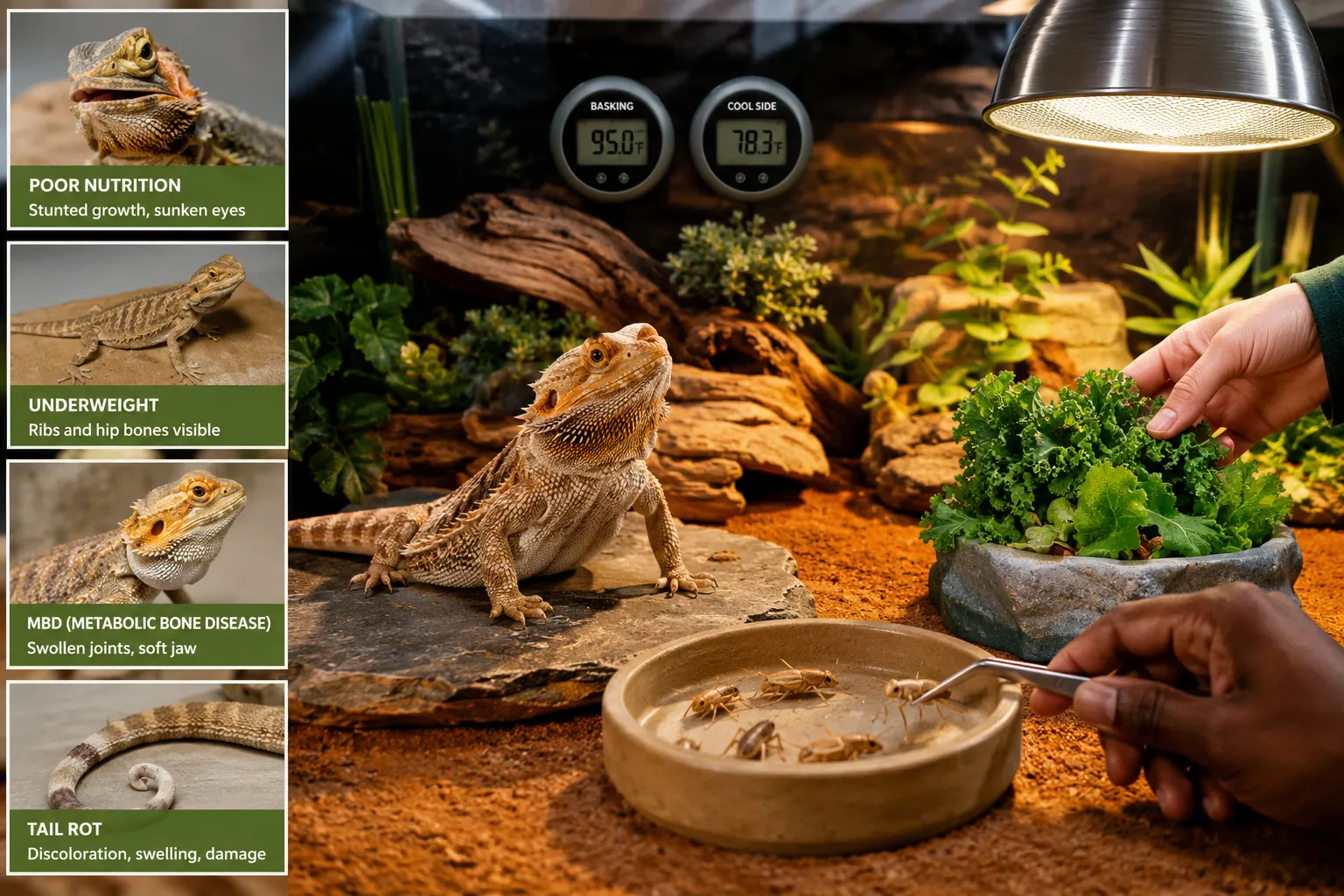
- Visible ribs, hip bones, or thin tail base
- Irregular or absent bowel movements
Common mistake: Comparing your dragon to online photos or other people’s dragons without knowing their age, sex, or genetics. A healthy 16-inch female is perfectly normal even if your friend’s male is 22 inches at the same age.
If your dragon shows healthy behaviors but measures small, focus on optimizing care conditions rather than forcing growth through overfeeding.
Difference Between Male and Female Bearded Dragon Growth Rates
Male bearded dragons grow 2-4 inches longer than females on average, with adult males reaching 18-24 inches compared to females’ 16-20 inches. Males also develop broader heads, thicker tail bases, and more pronounced femoral pores, though growth rates during the first 6 months are similar between sexes.
Sex-based growth differences:
Males:
- Final length: 18-24 inches (typically 20-22 inches)
- Final weight: 400-510 grams
- Broader, more triangular head shape
- Thicker tail base with visible hemipenal bulges
- More pronounced femoral pores (visible by 6-8 months)
Females:
- Final length: 16-20 inches (typically 17-19 inches)
- Final weight: 350-450 grams
- Narrower, more rounded head shape
- Slimmer tail base without bulges
- Smaller, less visible femoral pores
Growth timeline differences:
During months 0-6, males and females grow at nearly identical rates. Sexual dimorphism becomes apparent between 6-12 months as males begin their final growth spurt while females start slowing down. By 12 months, the size difference is usually obvious.
Choose male if: You want a larger display animal and have space for a larger tank setup. Choose female if: You prefer a more compact adult size or plan to house multiple dragons (though this requires careful planning).
How to Measure Bearded Dragon Length Properly
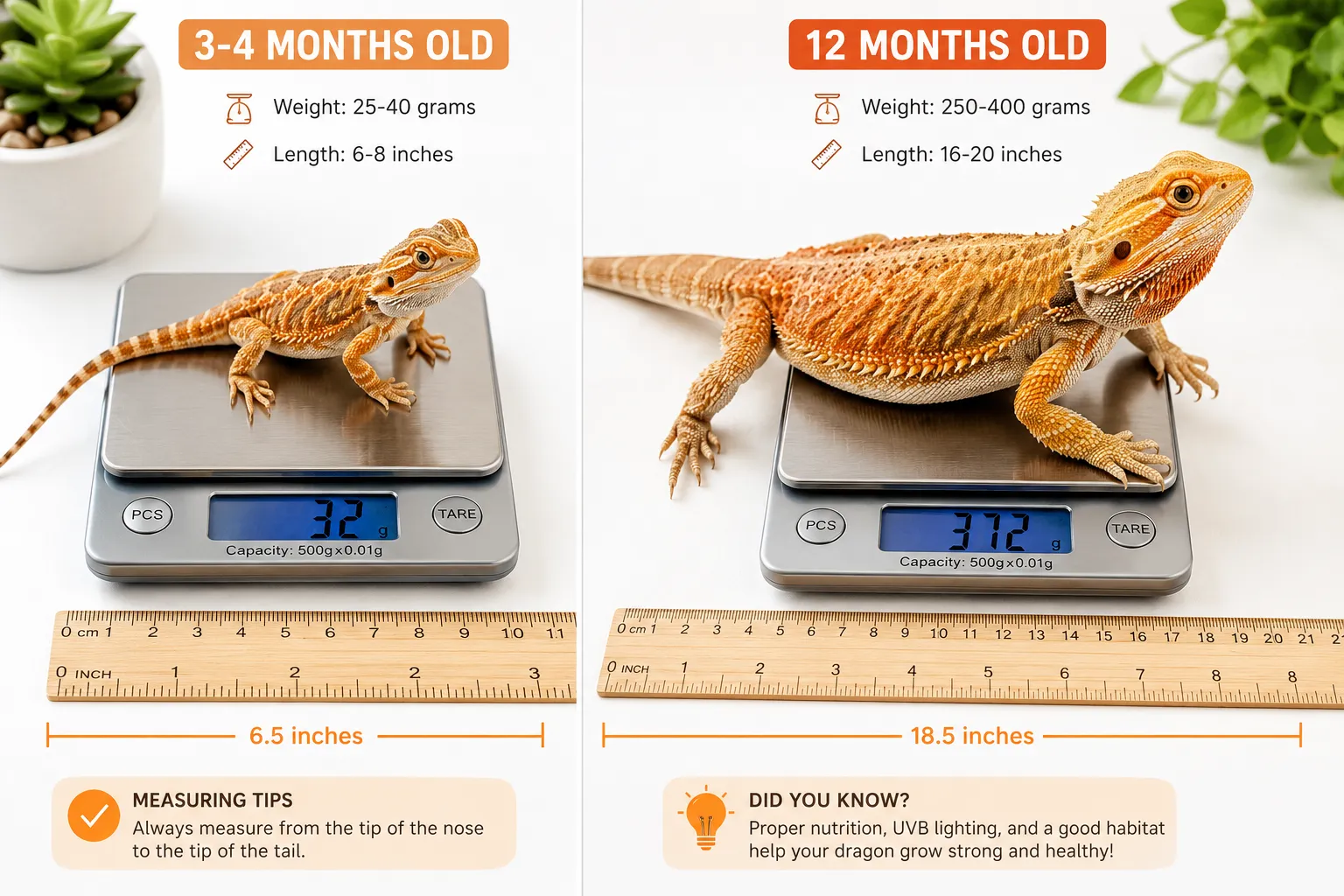
To measure a bearded dragon accurately, place the dragon on a flat surface and gently extend its body from a natural curved position to a straight line, then measure from the tip of the snout to the tip of the tail using a flexible measuring tape. Total length includes the tail, which comprises roughly 50-60% of the dragon’s overall measurement.
Step-by-step measuring technique:
- Wait for a calm moment – Don’t measure immediately after handling or feeding
- Place on flat surface – Use a table, floor, or inside their tank
- Allow natural positioning – Let the dragon settle into a relaxed posture
- Gently straighten – Carefully extend the body and tail into a straight line without forcing
- Measure snout to tail tip – Use a flexible fabric measuring tape, not a rigid ruler
- Record the measurement – Note the date for tracking growth over time
Common measuring mistakes:
- Measuring while the dragon is curved or coiled (underestimates length)
- Pulling the tail too hard to straighten it (can cause injury)
- Measuring only snout-to-vent length (SVL) instead of total length
- Using a rigid ruler that can’t follow body contours
Pro tip: Take three measurements and average them for accuracy. Dragons rarely hold perfectly still, so slight variations between measurements are normal.
For weight tracking, use a digital kitchen scale accurate to 1 gram. Weigh your dragon at the same time of day (morning before feeding is ideal) for consistent comparisons.
What Affects Bearded Dragon Growth Rate and Size?
Bearded dragon growth rate depends primarily on UVB lighting quality, dietary protein and calcium intake, basking temperature consistency, and genetics. Dragons with inadequate UVB exposure, insufficient protein during juvenile stages, or temperatures outside the 95-110°F basking range will grow more slowly and may not reach their genetic size potential.
Primary growth factors:
UVB lighting (most critical):
- Requires 10-12% UVB tube bulb replaced every 6-12 months
- Must be positioned 8-12 inches from basking spot
- Needed 10-12 hours daily for calcium metabolism
- Without adequate UVB, dragons cannot absorb dietary calcium regardless of supplementation
Diet quality:
- Juveniles need 70-80% protein (insects) and 20-30% vegetables
- Daily calcium supplementation with D3 for babies
- Variety in protein sources prevents nutritional deficiencies
- Gut-loaded insects provide better nutrition than unfed feeders
Temperature regulation:
- Basking spot: 95-110°F for babies, 95-105°F for adults
- Cool side: 75-85°F
- Nighttime: 65-75°F
- Proper gradient allows thermoregulation for digestion and metabolism
Genetics:
- Bloodline determines maximum size potential
- Some morphs (like German Giants) grow larger than standard morphs
- Clutch size affects hatchling size (larger clutches = smaller babies)
Tank size:
- Cramped enclosures can stunt growth through stress
- Babies need minimum 40 gallons; adults need 75-120 gallons
- Inadequate space limits exercise and natural behaviors
Edge case: Dragons from large clutches (25+ eggs) often start smaller but catch up to normal size by 12 months if care is optimal. Don’t assume a small hatchling will stay small forever.

Calcium supplement without Vitamin D3 is

Calcium is essential to reptiles for the prevention of metabolic bone disease

Is My Bearded Dragon Underweight for Its Age?
A bearded dragon is likely underweight if you can easily see its ribs, hip bones, or spine, if the tail base appears thin or concave rather than rounded, or if the dragon weighs 15-20% below the average range for its age and length. However, body condition is more important than weight alone, as naturally smaller dragons may weigh less while still being healthy.
Body condition assessment:
Healthy weight indicators:
- Ribs not visible but can be felt with gentle pressure
- Rounded, full tail base (not thin or wrinkled)
- Smooth body contours without prominent bones
- Alert, active behavior with strong grip
- Regular appetite and normal bowel movements
Underweight warning signs:
- Visible ribs, spine, or hip bones even when not stretched
- Thin, triangular tail base or visible tail bones
- Sunken appearance around hips
- Lethargy or weakness during handling
- Decreased appetite or difficulty catching prey
Weight-to-length guidelines:
- 12-inch dragon: 100-200 grams (healthy range)
- 16-inch dragon: 250-400 grams (healthy range)
- 20-inch dragon: 400-510 grams (healthy range)
Common causes of underweight dragons:
- Parasites (requires fecal exam and treatment)
- Inadequate feeding frequency or portion sizes
- Competition from tank mates (never house juveniles together)
- Stress from improper temperatures or handling
- Metabolic bone disease preventing proper nutrient absorption
If your dragon appears underweight, increase feeding frequency gradually and schedule a veterinary exam to rule out parasites or illness. Don’t suddenly overfeed, as this can cause digestive issues.
Common Mistakes That Stunt Bearded Dragon Growth
The most common growth-stunting mistakes include using compact UVB bulbs instead of tube fixtures, feeding only one type of insect, maintaining basking temperatures below 95°F, and housing juveniles in tanks smaller than 40 gallons. These husbandry errors prevent dragons from reaching their genetic size potential even when they appear otherwise healthy.
Top growth-stunting mistakes:
1. Inadequate UVB lighting
- Using compact/coil bulbs (insufficient coverage)
- Not replacing tube bulbs every 6-12 months
- Positioning UVB too far from basking spot (>12 inches)
- Fix: Install 10-12% UVB tube bulb 8-12 inches from basking area
2. Poor diet composition
- Feeding only mealworms or crickets (nutritional imbalance)
- Insufficient calcium supplementation
- Too many vegetables for juveniles (need 70-80% protein)
- Fix: Rotate 3-4 feeder insect types and dust with calcium daily
3. Temperature problems
- Basking spot below 95°F (slows metabolism and digestion)
- No temperature gradient (prevents thermoregulation)
- Using heat rocks (cause burns, don’t provide ambient heat)
- Fix: Use overhead basking bulb to achieve 95-110°F basking spot
4. Tank size too small
- Keeping juveniles in 20-gallon tanks (causes stress)
- Not upgrading as dragon grows
- Fix: Minimum 40 gallons for babies, 75-120 gallons for adults
5. Inconsistent feeding schedule
- Skipping days during rapid growth phases
- Free-feeding (leaving insects in tank)
- Fix: Feed juveniles 2-3 times daily on a consistent schedule
6. Stress factors
- Cohabitation with other dragons (competition and stress)
- Excessive handling during adjustment period
- Loud noises or vibrations near tank
- Fix: House individually and minimize stress during first 2-3 months
Edge case: Some dragons experience temporary growth slowdowns during brumation (winter dormancy), which is natural and doesn’t indicate a problem. Growth resumes when they become active again.
Do Different Bearded Dragon Morphs Grow at Different Rates?
Most bearded dragon morphs (color and scale variations) grow at similar rates and reach comparable adult sizes of 16-24 inches, with the notable exception of German Giant morphs, which can reach 24-28 inches. Color morphs like hypomelanistic, translucent, and leatherback dragons follow standard growth patterns, though some scale mutations may slightly affect size.
Morph-specific growth patterns:
Standard morphs (same growth rate):
- Normal/wild-type
- Hypomelanistic (reduced dark pigment)
- Translucent (clear scales, solid black eyes)
- Red, orange, yellow, citrus (color variations)
- Expected size: 16-24 inches
German Giant bloodline:
- Selectively bred for larger size
- Reach 24-28 inches (some exceed 28 inches)
- Require larger enclosures (minimum 120 gallons)
- Same growth timeline (18-24 months) but continue to larger final size
Scale mutation morphs:
- Leatherback: Reduced scale size, slightly smaller build (15-22 inches typical)
- Silkback: No scales, often smaller and more fragile (14-20 inches typical)
- Dunner: Irregular scale pattern, standard size
Important considerations:
Silkback dragons require specialized care and often don’t reach full size potential due to their fragile skin and increased health challenges. They’re not recommended for beginners.
Witblits and zero morphs (pattern-less) grow at standard rates despite their unique appearance. The absence of pattern doesn’t affect growth.
Common misconception: Translucent dragons are often smaller because the translucent gene is lethal when homozygous (two copies), so all translucents are heterozygous and may carry size-limiting factors. However, well-bred translucents reach normal sizes.
How Much Should I Feed My Bearded Dragon Based on Age and Size?
Feed baby bearded dragons (0-4 months) 2-3 times daily with as many appropriately-sized insects as they’ll eat in 10-15 minutes, plus fresh vegetables offered daily. Juveniles (4-12 months) need 1-2 feedings daily of 20-50 insects total, while adults (12+ months) should eat primarily vegetables with insects 3-4 times weekly.
Age-based feeding guidelines:
Hatchlings (0-2 months):
- 3 feedings daily
- 10-20 small insects per feeding (30-60 daily total)
- Insect size: no larger than space between eyes
- Vegetables offered but rarely eaten
- Calcium with D3 daily, multivitamin 2x weekly
Juveniles (2-7 months):
- 2-3 feedings daily
- 20-40 insects per feeding (40-80 daily total)
- Insect size: space between eyes or slightly larger
- 70-80% insects, 20-30% vegetables
- Calcium with D3 daily, multivitamin 2x weekly
Sub-adults (7-12 months):
- 1-2 feedings daily
- 20-30 insects per feeding (30-50 daily total)
- Transition to larger insects (dubia roaches, hornworms)
- 50-60% insects, 40-50% vegetables
- Calcium with D3 5x weekly, multivitamin 2x weekly
Adults (12+ months):
- Insects 3-4 times weekly
- 10-20 insects per feeding
- Daily fresh vegetables (unlimited)
- 20-30% insects, 70-80% vegetables
- Calcium without D3 daily on vegetables, multivitamin 1x weekly
Insect size rule: Feeders should be no larger than the space between your dragon’s eyes to prevent impaction. For babies, this means pinhead crickets or small dubia nymphs.
Common feeding mistakes:
- Overfeeding adults (leads to obesity)
- Underfeeding juveniles during rapid growth
- Feeding insects that are too large
- Not gut-loading feeder insects before offering
- Leaving uneaten insects in tank (can bite dragon)
For more detailed guidance on feeding schedules, check our comprehensive feeding guide.
Signs of Healthy Growth in Baby Bearded Dragons
Healthy baby bearded dragons display consistent growth of 1-2 inches monthly, shed every 3-6 weeks, maintain voracious appetites, show alert and active behavior, and produce regular bowel movements. Weight gain should be steady, with babies doubling their weight every 4-6 weeks during peak growth months.
Healthy growth indicators:
Physical signs:
- Bright, clear eyes (not sunken or cloudy)
- Firm, rounded body (not bloated or thin)
- Strong, coordinated movement
- Complete, regular sheds without retained skin
- Vibrant coloration appropriate to morph
- Well-formed limbs without swelling or deformities
Behavioral signs:
- Eager feeding response (chases insects actively)
- Alert head tracking when you approach
- Basking behavior (spends time under heat lamp)
- Exploration and climbing in enclosure
- Normal defensive behaviors (beard puffing when startled)
Growth metrics:
- Length increase: 1-2 inches per month (0-7 months)
- Weight gain: 10-50 grams per month depending on starting size
- Shedding frequency: Every 3-6 weeks for babies
- Appetite: Eating 30-80 insects daily (age-dependent)
Red flags requiring veterinary attention:
- No growth for 6-8 weeks
- Weight loss or failure to gain weight
- Lethargy or constant hiding
- Refusing food for more than 3 days
- Tremors, twitching, or seizures (MBD symptoms)
- Swollen limbs or curved spine
- Labored breathing or gaping mouth (not during basking)
Edge case: Brief appetite decreases during shedding are normal. Dragons often eat less for 2-3 days before and during a shed, then resume normal eating afterward.
Track your baby dragon’s growth with monthly measurements and weekly weigh-ins to catch problems early. Consistent, steady progress is more important than hitting exact chart numbers.
Conclusion
Understanding the bearded dragon growth chart by age helps you provide appropriate care at every life stage and recognize potential health issues early. Most bearded dragons grow from 3-4 inches at hatching to 16-24 inches by 18-24 months, with the fastest growth occurring during the first seven months of life.
Remember that individual variation is normal. Focus on consistent growth trends, healthy behaviors, and proper body condition rather than comparing your dragon to exact chart numbers. Males naturally grow larger than females, and genetics play a significant role in final adult size.
Action steps for supporting healthy growth:
- Verify your UVB setup – Ensure you’re using a 10-12% tube bulb positioned 8-12 inches from the basking spot and replace it every 6-12 months
- Optimize temperatures – Maintain a 95-110°F basking spot for babies and 95-105°F for adults with a proper gradient
- Feed age-appropriately – Follow the feeding guidelines for your dragon’s life stage, with babies eating 2-3 times daily and adults transitioning to mostly vegetables
- Track growth monthly – Measure length and weight consistently to identify growth plateaus or concerns early
- Provide adequate space – Upgrade tank size as your dragon grows, with adults needing 75-120 gallons
If your dragon falls outside typical growth ranges but displays healthy behaviors, maintains steady (even if slow) growth, and shows no signs of illness, it may simply be naturally smaller or larger than average. When in doubt, consult a reptile veterinarian for a professional assessment.
For more guidance on bearded dragon care and understanding their behavior, explore our comprehensive resource library.
FAQ
How long does it take for a bearded dragon to reach full size?
Most bearded dragons reach full adult size between 18-24 months of age, though some individuals continue growing until 30 months. Males typically finish growing around 18-20 months, while females often complete growth by 16-18 months.
What size should a 6-month-old bearded dragon be?
A healthy 6-month-old bearded dragon should measure 11-18 inches in total length and weigh between 183-188 grams. At this age, dragons are in their peak growth phase and should be eating voraciously and shedding frequently.
Can poor diet permanently stunt a bearded dragon’s growth?
Yes, inadequate nutrition during the first 12 months can permanently limit a bearded dragon’s final adult size. However, improving diet and husbandry can help dragons reach closer to their genetic potential even after early deficiencies, though they may never fully catch up.
How often should I weigh my baby bearded dragon?
Weigh baby bearded dragons weekly during their first six months to track growth trends and catch problems early. After six months, bi-weekly or monthly weigh-ins are sufficient unless you’re monitoring a specific health concern.
Do bearded dragons grow faster with more food?
No, overfeeding doesn’t accelerate healthy growth and can cause obesity, fatty liver disease, and other health problems. Growth rate is primarily determined by genetics, UVB exposure, and temperature, not food quantity. Feed age-appropriate portions rather than trying to force faster growth.
Why did my bearded dragon stop growing suddenly?
Sudden growth plateaus can indicate inadequate UVB lighting, incorrect temperatures, parasites, illness, or the onset of brumation (winter dormancy). If the plateau lasts more than 8 weeks and your dragon shows other concerning symptoms, consult a reptile veterinarian.
Is a 16-inch bearded dragon considered small?
A 16-inch bearded dragon is within normal range for an adult female or a young male still growing. Adult females typically reach 16-20 inches, while adult males reach 18-24 inches. Size alone doesn’t indicate health; body condition and behavior are more important.
How can I tell if my bearded dragon is growing properly?
Monitor for consistent monthly length increases (1-2 inches for babies), steady weight gain, regular shedding every 3-6 weeks, strong appetite, and alert behavior. Healthy dragons should show continuous progress rather than sudden spurts or long plateaus.
Do bearded dragons grow in spurts or continuously?
Bearded dragons grow relatively continuously during their first year, though growth rates vary by life stage. Some owners notice slight growth spurts around 4-6 months, but overall growth should be steady rather than dramatic spurts followed by long plateaus.
What’s the difference between snout-to-vent length and total length?
Snout-to-vent length (SVL) measures from the nose to the vent (cloaca) excluding the tail, while total length includes the tail. Most growth charts use total length, which is typically 2-2.5 times the SVL. Always clarify which measurement you’re comparing.
Can stress affect bearded dragon growth rate?
Yes, chronic stress from improper housing, cohabitation, excessive handling, or environmental factors can slow growth by suppressing appetite and metabolism. Stressed dragons may eat less, hide more, and grow more slowly than their relaxed counterparts.
How much bigger do male bearded dragons get than females?
Males typically grow 2-4 inches longer than females, with adult males reaching 18-24 inches compared to females’ 16-20 inches. Males also develop broader heads, thicker tail bases, and generally weigh 50-100 grams more than females of similar length.

Perfect Blend of Crickets, Mealworms and Pellets

New Fluker's Crafted Cuisine Juvenile Bearded Dragon Diet (6. 75 oz. )

This food is natural with added vitamins, minerals, and other trace nutrients. There are no artificial colors, flavors, or preservatives added!